A memory care facility is a residential community for people living with Alzheimer's disease or other dementias. It combines personal care, supervision, structured activities and an environment designed around dementia-related needs. Dementia affects tens of millions of people worldwide, and that number is growing.
A parent may start leaving the stove on, missing medication or getting lost on a familiar walk. You may be weighing whether more help at home is enough, or whether a community can provide steadier support. The label “memory care” alone does not prove a place is safe or suitable. Before touring, ask what staff do each day, how they respond to incidents, and whether their licensing and staffing practices match your parent's changing needs.
What a Memory Care Facility Is and Who It Serves
A daughter might first notice that her father can no longer manage his morning routine alone. He forgets to eat, needs help getting dressed, and sometimes can't find the bathroom in his own home. A memory care facility is a residential community designed for people with Alzheimer's disease or other dementias, bringing together accommodation, meals, personal-care assistance, supervision, structured activities and safety measures.
Think of it as a building designed for someone who can't reliably use memory to find the bathroom, remember a meal or recognize a hazard. Clear paths, familiar routines and attentive staff carry part of the load, helping the resident manage daily life with support. The World Health Organization's dementia information projects that the global number of people living with dementia will reach 78 million by 2030 and 139 million by 2050.
Memory care is a specialized long-term-care setting, not just an apartment with optional extras. Staff may assist with dressing, bathing, meals, and medications while offering activities and supervision designed for the individual. The community can coordinate with family and healthcare professionals, but it isn't automatically a hospital or skilled-nursing facility. Medical, behavioral, and mobility needs may require services the community doesn't provide directly.
A typical resident needs more supervision, redirection or daily assistance than they can get living alone or in standard assisted living. But dementia affects people differently, so the label alone can't tell you whether a particular place is suitable.
Practical rule: Judge the community by what it can do for your loved one each day, not by the name on the sign.
Memory Care Settings and Community Sizes
| Setting | How It Is Organized | What to Verify |
|---|---|---|
| Dedicated memory care community | Serves only residents with dementia | Dementia staff training and secured exits |
| Designated dementia wing | Secured unit inside a broader assisted living community | Whether residents can stay in the wing as needs change |
| Large multi-level campus unit | Memory care unit within a larger senior campus | How units are separated by stage of dementia |
These settings can look very different in practice. A dedicated community may be small and focused on dementia care; a wing may share a campus, dining services or staff with assisted living; and a larger campus may organize residents into different areas. Ask how the unit operates, rather than inferring its services from its layout or marketing.
In a 2022 CDC survey, 28.7% of U.S. Residential care communities either served only residents with dementia or had a designated dementia unit or wing. The survey also found that 42% of residents in residential care communities had a dementia diagnosis, showing that dementia support matters even in settings that aren't exclusively memory care. These figures describe residential care communities overall, not the performance of a particular memory care option. The CDC's National Center for Health Statistics survey reported that 57.1% of residential care communities had 4 to 25 beds, 13.6% had 26 to 50 beds and 29.3% had more than 50 beds.
A smaller home may feel more like a household, with shared routines and familiar staff. A large campus may offer more program options or separate residents into units. Neither size guarantees better care: ask who works in the memory care area, how residents spend the day and what happens when someone's needs change. The same survey found that 81.9% of residential care communities were for-profit, but ownership status alone doesn't tell you whether the care is good.
Services Included in Daily Memory Care
In the morning, a staff member may help a resident wash, dress and use the bathroom, then walk with them to breakfast. At the table, gentle prompts can help the person eat and drink. Later, a trained staff member may provide scheduled medication, and an activity leader might invite residents to listen to music, help prepare a simple snack or take a short walk.
| Service | Typical Day Example | What to Confirm on a Tour |
|---|---|---|
| Personal care | Help with bathing, dressing and toileting | Staff coverage during busy morning hours |
| Meals and hydration | Prompts and assistance at breakfast and lunch | How intake is tracked and who reports poor eating |
| Medication support | Scheduled doses given by trained staff | Who manages changes and how errors are logged |
| Structured activities | Music, cooking, walks at calm times of day | Activity calendar and how it's adapted for each resident |
| Supervision and wandering response | Watchful presence without restraint | How wandering is assessed and what staff do first |
| Sleep and evening routine | Calm room setup and night checks | How late-day agitation is handled without routine sedation |
| Family communication | Updates on mood, eating and incidents | How often families receive updates and whom to call |
The amount of help depends on the resident's abilities and care plan. Some clinical services require licensed nursing; a community may coordinate with outside clinicians instead of providing those services itself. Ask how many staff are present on each shift, including evenings and overnight, and who updates the care plan when the resident's needs change.
A predictable day can make unfamiliar surroundings easier to manage, but routines should reflect the person rather than impose the same schedule on everyone. Families looking for a practical overview of how care can respect individual history and preferences can explore person centred approaches to dementia care.
Before choosing a community, ask:
- What matters to my parent? How will staff learn their preferred foods, music, daily habits and ways of communicating?
- What happens when they refuse help? Ask for a specific example of how staff respond calmly and preserve dignity.
- How will I hear about changes? Find out who contacts the family about new concerns, incidents or changes to the care plan.
Secure Design Features That Prevent Harm
Dementia can affect gait, balance and the ability to recognize danger. A cluttered hallway, confusing sign or poorly lit bathroom can add to the risk of falls and distress. The building is part of the care, but a locked door by itself doesn't make a setting safe or responsive.
Look for clear wayfinding, such as picture signs and contrasting colors, along with lighting that reduces glare. Hallways should allow residents to move without obstacles. Bathrooms and dining spaces should be easy to see and reach; grab bars, sturdy handrails, contrasting fixtures and nonslip bathing surfaces can make common tasks more manageable. Exterior doors may be controlled or have alerts, but staff still need clear procedures for responding.
The Alzheimer's Association describes these types of environmental features as part of a supportive setting designed to reduce confusion and prevent unsafe exits. Its guidance on dementia-friendly environments also underscores why staff should assess the person's circumstances, not treat every movement as a problem. Someone heading toward a door may be in pain, bored, disoriented or trying to meet an unmet need. Understanding the reason can lead to a more useful response than blocking the person.
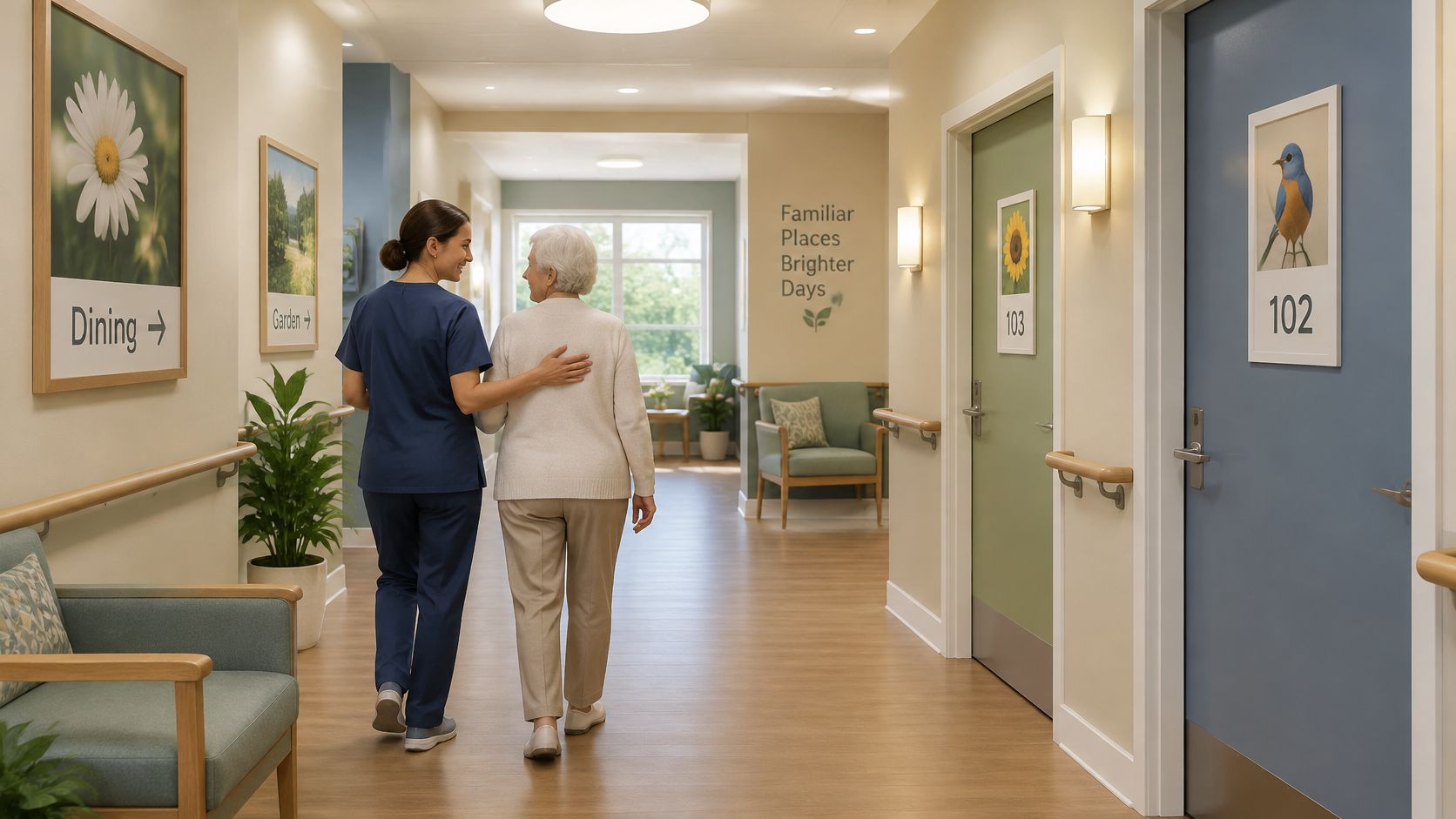
“Secure” is a claim to test during a visit. A useful starting point is to ask how decisions about restricted access are made and who is legally authorized to make them. For families navigating guardianship, an explanation of court permission for a Texas ward's move can help illustrate why a move to a locked unit may raise legal as well as care questions.
During a tour:
- Test the alert process. Ask staff to demonstrate how a door alert works and what happens when it activates.
- Ask about individual assessments. How are wandering and fall risks evaluated and recorded for each resident?
- Look for follow-through. Ask for an example of an intervention matched to a resident's reason for wandering.
- Check maintenance practices. Ask when staff last audited the environment for hazards and how they document corrections.
Signs a Loved One May Need Memory Care
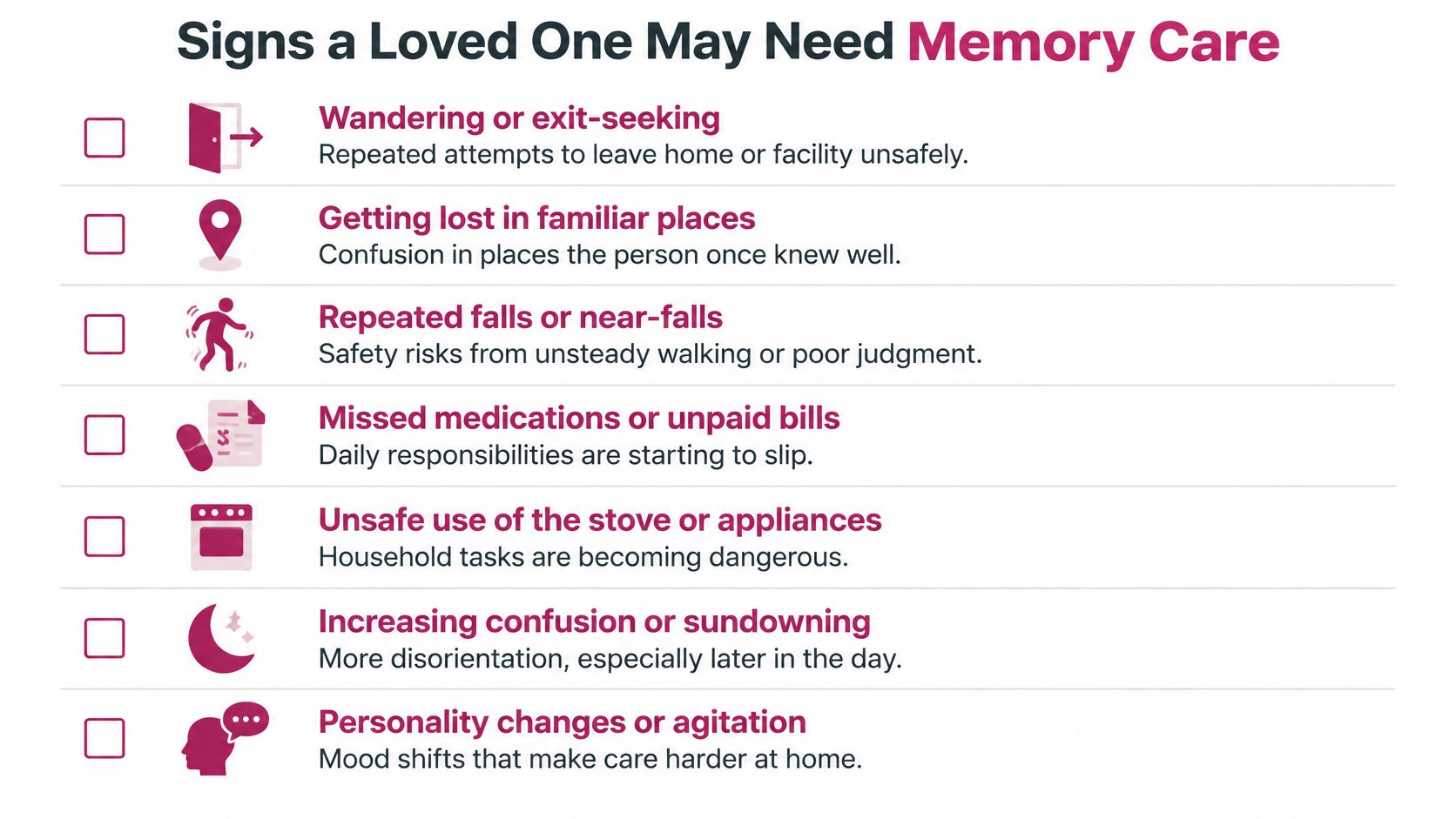
A move may become worth considering when family support can no longer reliably cover safety and daily needs. Pay attention to patterns such as:
- Wandering or exit-seeking, including attempts to leave home unsafely.
- Getting lost in familiar places or struggling to find one's way in a known home.
- Repeated falls or near-falls that raise concern about supervision and mobility.
- Missed medication or unpaid bills that the person previously managed.
- Unsafe use of appliances, such as leaving a stove on or using it incorrectly.
- Increasing distress or unusual behavior, including agitation, aggression or hallucinations.
- Weight loss or neglected hygiene, which may signal difficulty eating or completing personal care.
- Caregiver exhaustion that makes the current arrangement hard to sustain safely.
A review cited in the Online Journal of Issues in Nursing reported that 75% of people with dementia experienced at least one behavioral symptom within a 30-day period. Symptoms can include agitation, aggression, hallucinations, delusions, apathy and wandering, and their meaning varies from person to person. The review's discussion of dementia care transitions and behavioral symptoms is a reminder that a secure setting isn't automatically the right fit for every need.
A fall, an unsafe exit or a serious change in behavior is a reason to arrange a formal assessment with the person's doctor, rather than waiting for another incident. Ask whether a facility can respond to psychiatric symptoms, frequent falls, complex medical needs and end-of-life care, and what circumstances would lead to a transfer elsewhere. A community may not have the clinical staff or services to manage every stage of dementia.
If you're sorting through patterns of change, this guide to signs a parent may need memory care in New Jersey offers another way to organize your concerns. Before deciding on a move, seek a medical assessment so the placement reflects documented care needs, not just a frightening incident or a sales claim.
Memory Care vs Assisted Living vs Nursing Homes
| Feature | Assisted Living | Memory Care | Nursing Home |
|---|---|---|---|
| Main purpose | Help with daily living in a home-like setting | Daily living support plus dementia-specific design and programs | Round-the-clock clinical and rehabilitative care |
| Who it suits | Seniors who need some help and are mostly oriented | People with dementia who need supervision, redirection and a safe layout | People who need daily licensed nursing or rehab |
| Secured environment | Usually not designed for it | Often includes controlled exits and a dementia-designed layout | Some facilities have dementia special-care units |
| Dementia staffing | Ask what training staff receive | Dementia-trained staff are central to the model | Ask about special-care unit training |
| Medical care | Usually coordinated through outside providers | Coordinated with outside clinicians; not a hospital | Skilled nursing available around the clock |
| Typical setting | Residence or apartment-style community | Dedicated community, wing or unit | Licensed facility with clinical units |
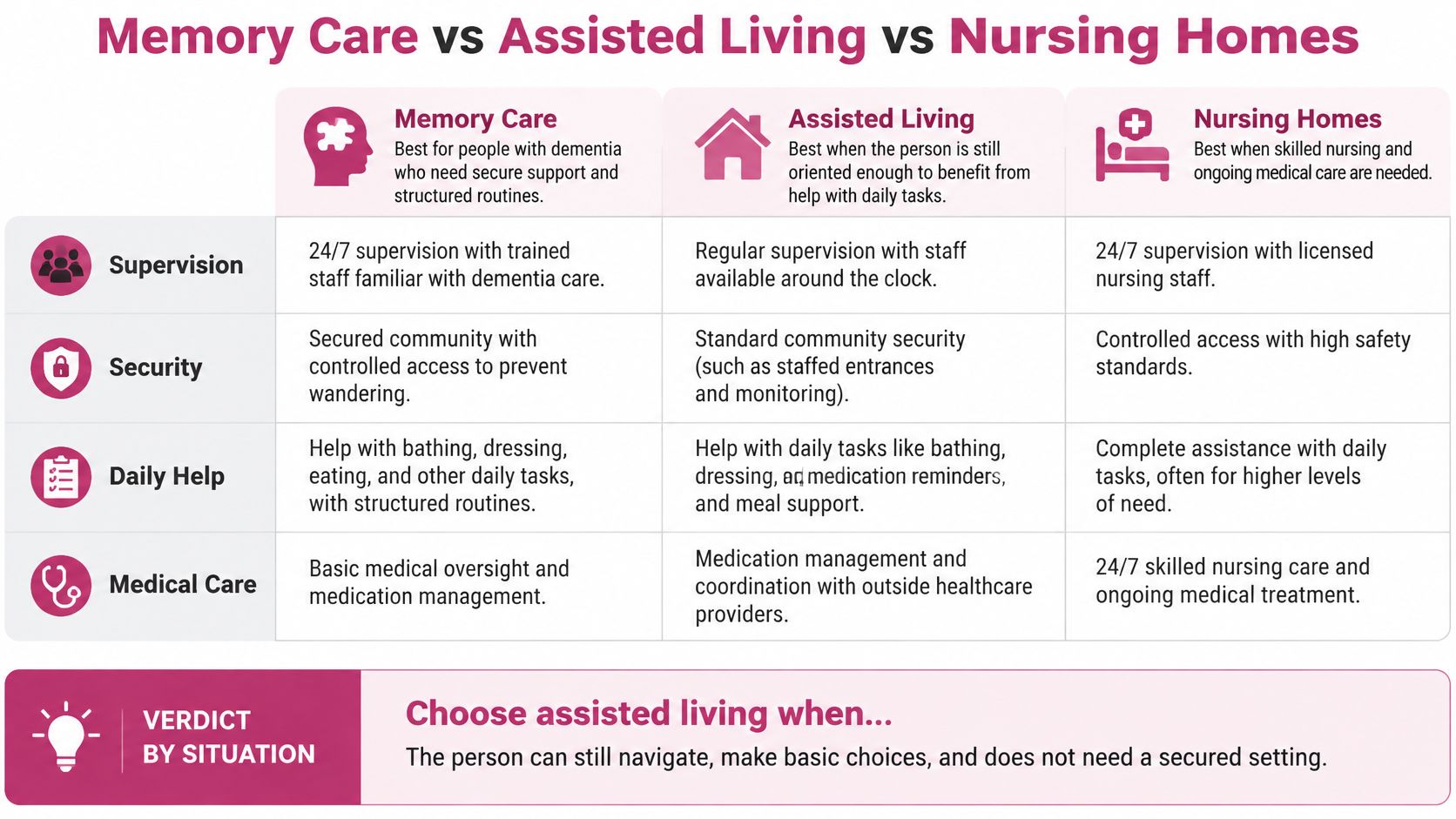
Choose assisted living when your loved one can still get around the setting, follow familiar routines and accept help with daily tasks, and doesn't need a secured environment. Assisted living is a little like a hotel with help: residents have a home-like setting and assistance, but the layout and staffing may not be built around dementia-related risks.
Choose memory care when memory loss contributes to unsafe behavior, wandering or a need for closer supervision and structured routines. Think of it as a home designed around a specific set of hazards, with dementia-aware staff and a layout intended to reduce confusion. But “memory care” isn't a guarantee that every resident can stay as their needs progress. Ask how the community handles changes in mobility, behavior and medical care.
Choose a nursing home when your loved one needs ongoing licensed nursing or rehabilitation beyond what a memory care community can provide. A nursing home is more like a clinic with bedrooms: clinical care is central, though the type and level of dementia support still need to be checked.
The categories overlap. An assisted living community may include a memory care wing, and a resident may move between settings when their needs change. Ask what the community can provide now, what it can take on later and what would trigger a transfer. The right decision should account for the care your loved one may need over the coming months, not just the support they need today.
New Jersey Licensing and Quality Checks to Run
Start by confirming the community's license and its current status with the New Jersey Department of Health. Ask whether the dementia unit is included in the licensed area, then request the most recent state inspection report and any plan of correction. Read the findings closely for issues involving supervision, medication or falls, and ask the administrator what changed afterward.
Then request operating details that help you check what the “memory care” label means in practice:
| Quality Metric | Why It Matters | What to Request |
|---|---|---|
| Share of residents with dementia | Resident mix can indicate how specialized daily operations are | Current census percentage |
| Direct-care and nursing hours by shift | Shows coverage, including nights and weekends | Staffing schedule for each shift |
| Staff dementia training and turnover | Training and continuity matter to familiar, consistent care | Training records and annual turnover rate |
| Hospital transfers and emergency visits | Helps you understand how needs are managed on site | Transfer and emergency visit counts for the past year |
| Falls and elopement incidents | Offers context on supervision and environmental risks | Incident logs and corrective actions |
| Antipsychotic medication use | Helps clarify whether non-drug approaches are considered | Policy, use rate and review process |
| Dedicated dementia unit | Shows whether specialized care has a defined area | Floor plan and unit description |
A high share of residents with dementia may be one indicator of specialization, but it doesn't prove that a community provides high-quality care. An NIA-funded study summarized by the Centers for Medicare & Medicaid Services found that nursing homes with more than 90% of residents with dementia had better dementia-related outcomes than facilities with lower concentrations. That finding is from nursing-home data, so use it as a question to test with a memory care community, not proof that a residential memory care setting will produce the same results.
Ask to compare reports across shifts and years, where available. A single figure can hide whether staffing changes overnight, whether incidents are rising or whether the facility made improvements. For help interpreting findings, see this guide to reading a New Jersey assisted living inspection report, then verify the license and reports directly with the state.
What Happens in the First Weeks After Admission
An unfamiliar setting can increase confusion and distress, especially if staff don't know what helps the resident feel settled. Plan the handoff so the team learns more than a diagnosis and medication list.
- Before move-in, write a personal profile. Include routines, favorite foods, sleep habits, topics or situations that cause distress, and calming approaches that have worked.
- During the first week, confirm who's responsible. Ask which staff members received the information and where it's recorded in the care plan.
- Request a care plan review after staff have observed the resident. Ask what the team has noticed, what it changed and whether your family should update the profile.
Hospital-to-facility moves need particular care. A hospital stay may change behavior or disrupt familiar routines, and staff at the receiving community need a clear handoff. Ask for the discharge summary and a medication review before arrival, and identify whom the facility will call if the resident's condition changes.
Settle transfer questions before move-in: what symptoms, falls or medical needs might lead the community to recommend another setting? Can the resident remain if their care needs rise? Because updates can come from different people, keep one written log of questions, answers and the staff member who provided each response.
Confirm the Right Care Level and Shortlist Vetted Options
- Confirm the level of care. Use observed safety and daily-living needs as a starting point, and arrange a medical assessment before a move when possible.
- Check the community's record. Gather its license status, latest inspection report and answers to questions about staffing, incidents and clinical support.
- Shortlist and tour. Compare the setting, daily routines, design, communication practices and admission process in person.
Life Senior Placement is a New Jersey placement service and directory that offers families no-cost guidance. It uses a structured intake to record health needs, budget, lifestyle and preferred location, then helps match families with licensed, vetted options and coordinate tours. Families should know that participating communities compensate the service. Its senior placement services include support comparing care types and coordinating the decision process; you can also search by city, ZIP code or community.
When you speak with an advisor, bring your list of care questions and ask how each suggested community will address them. One named contact can help coordinate conversations and tours, but you should still verify each facility's license, inspection record and capabilities yourself.
Hear more about planning a senior care search:
To discuss a New Jersey memory care search, call (862) 398-2006 or email hello@seniorplacement.life. You can also begin the intake online and share your parent's needs, preferred location and questions before scheduling tours.
Life Senior Placement offers no-cost guidance, curated options and tour coordination for New Jersey families comparing memory care and other senior care settings. Bring your questions about staffing, safety and licensing, then visit Life Senior Placement to start building a shortlist.