
A parent needs a new living arrangement after a hospital stay, but the family still isn't sure whether assisted living, memory care, skilled nursing, or home care is the right fit. The move-in timeline is tight, the budget is unclear, and every search result seems to promise a different version of the same thing. A senior living directory can narrow the field by city or ZIP code, but no single database reliably combines current availability, complete pricing, licensing, clinical quality, resident experience, and personal fit.
That distinction matters because the need for organized senior-care information is growing. The share of people aged 65 and older in the United States was projected to rise from 12.4% in 2000 to 19.6% by 2030, while the number of older adults was projected to increase from approximately 35 million to 71 million, according to the CDC's demographic projections. Families need a process that separates discovery from verification.
Use broad directories to build a local shortlist. Use official and specialized tools to check licensing, inspections, dementia resources, and quality. Then use direct calls, tours, and, when appropriate, guided placement support to reconcile what the listings say with what a community can offer. If you're also preparing a parent's apartment for a safer transition, this guide to senior furniture from Meliusly can help with practical home decisions.
1. Life Senior Placement
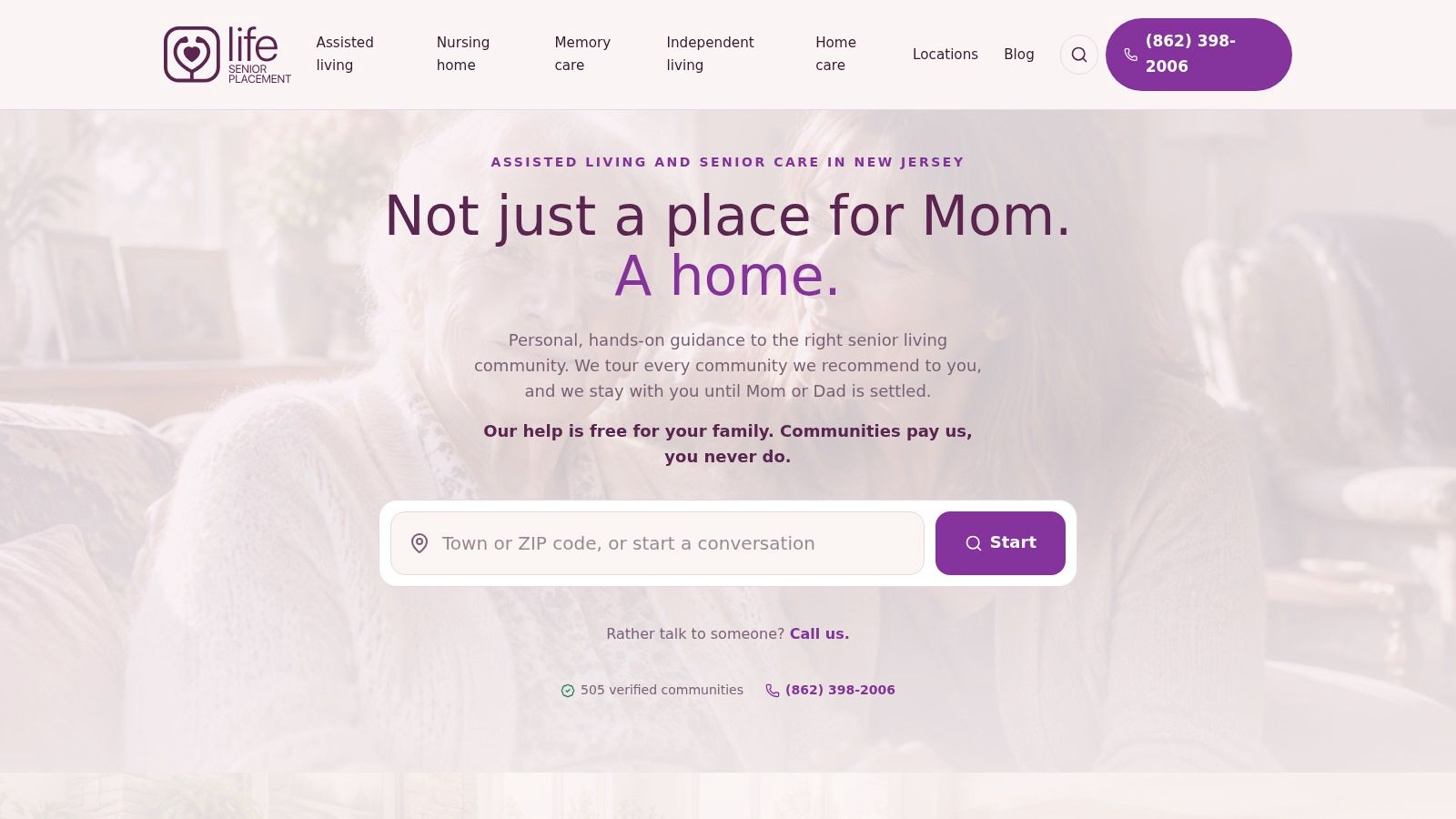
A New Jersey family facing a tight move-in timeline may need more than a directory search. Life Senior Placement combines a searchable directory with no-cost placement guidance for assisted living, memory care, nursing homes, independent living, and home care. Its coverage includes all 21 New Jersey counties, and the process centers on intake, curated matches, tours, and move-in coordination rather than an unfiltered results page.
The directory lists verified communities matched to New Jersey state license records and reviewed by the Life team. Advisors have New Jersey senior-care experience, including a Certified Assisted Living Administrator on staff, and the company says its advisors tour the communities they recommend. That local focus can help families compare care levels, location, budget, and urgency in one conversation.
Where the service earns its place
The service is most useful after a hospital discharge or when relatives cannot contact every community themselves. Advisors can ask about open rooms, coordinate paperwork, arrange tours or virtual walkthroughs, and remain a central contact through move-in. Families do not pay for the service. Participating communities pay placement fees after a move-in, and Life states that those fees do not change the family's rent.
The network creates a clear limitation. Recommendations come from participating providers, so ask which communities in the target area are included and which are not. Families can broaden the check with this New Jersey senior placement services guide, then confirm each finalist through official state records.
Practical rule: Use Life for a curated New Jersey shortlist and tour coordination. Still ask every community about staffing, fees, services, licensing, and current availability.
Life also offers local pricing context for assisted living, nursing homes, memory care, and independent living. These figures are medians or estimates, and actual costs vary by room type, care level, and town. Request a written estimate that separates base rent, care-level charges, medication management, deposits, one-time fees, transportation, and likely increases.
For a repeatable search, enter the city or ZIP code, use the results to create an initial shortlist, and ask Life which options match the care need and timeline. Then compare the recommendations with state records and direct calls. If directory details conflict with a community's current answer, treat the direct, written response as the item requiring follow-up.
Best for: New Jersey families, urgent placements, advisor-supported comparisons, and searches across several care types.
Pros: Free for families, local expertise, verified listings, community tours, and move-in support.
Cons: New Jersey only, with recommendations limited to a participating-provider network.
Website: Life Senior Placement
2. A Place for Mom
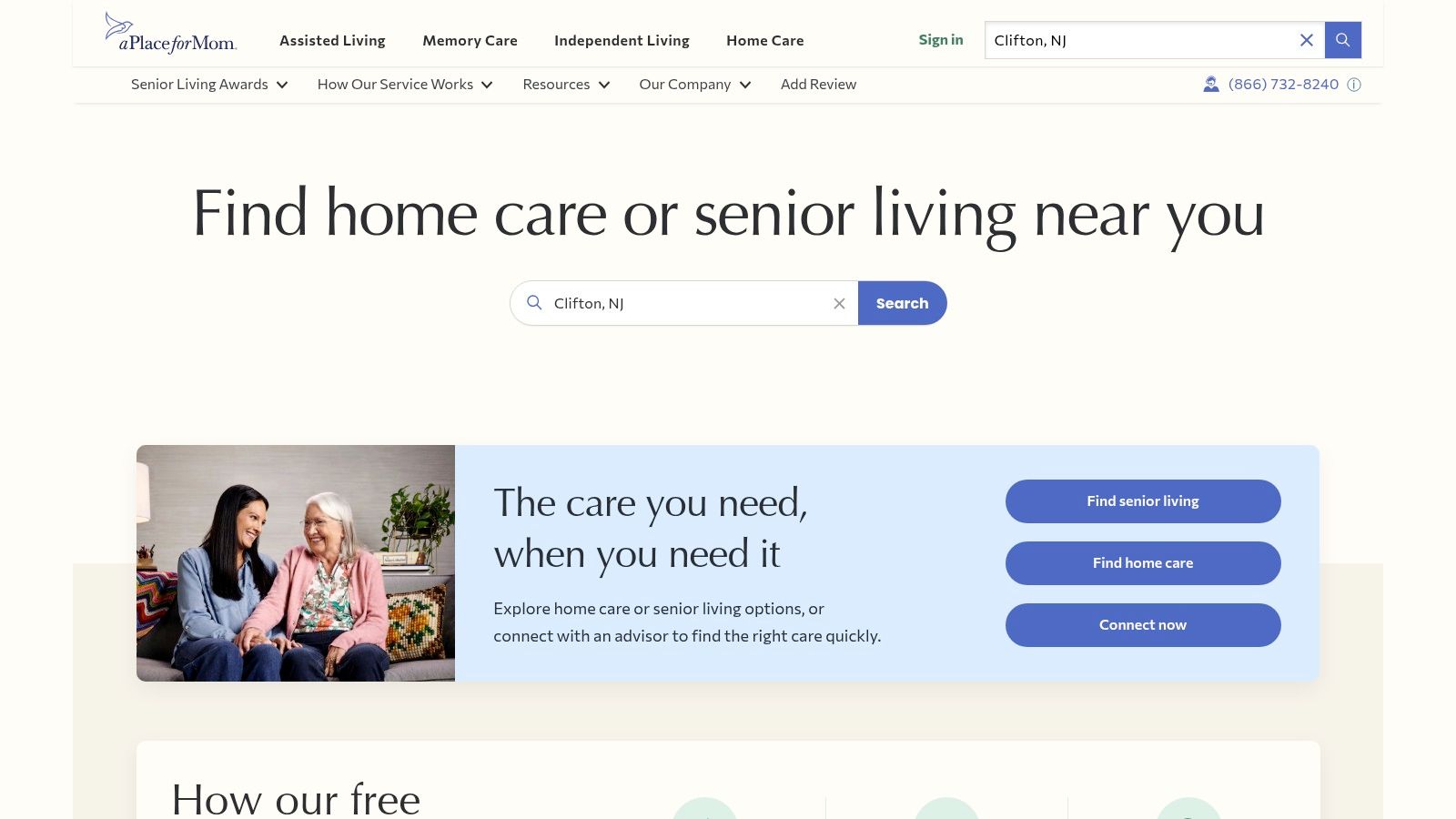
A Place for Mom is useful when a family needs broad national discovery quickly. Its directory covers assisted living, memory care, independent living, and home care, while its advisors can help families create a shortlist, arrange tours, and coordinate a move after a hospitalization. The scale makes it a practical first pass when relatives live in different states or don't know which communities operate in a target city.
Its annual cost reports and market benchmarks can help establish a rough budget before families start calling. Provider reviews and recognition badges, including Caring Stars and Best of Senior Living designations, can add another comparison layer. Those signals are useful for prioritizing calls, but they shouldn't be treated as proof of current staffing or care quality.
The lead-generation trade-off
The service is free to families because participating communities pay for referrals. That model doesn't automatically make the listings unsuitable, but it changes how families should use the tool. After submitting an inquiry, expect follow-up from advisors and communities. If several family members are searching, agree on one contact person and keep a written record of every recommendation.
A listed price may still require direct confirmation. Ask whether the figure includes care, medication support, meals, transportation, and a specific room type. Then ask whether the community has an opening now, a scheduled opening, or only a waitlist.
Best for: National discovery, quick introductions, and families that want human help alongside a large directory.
Pros: Broad coverage, advisor support, cost reports, and help with tours.
Cons: Follow-up can be persistent, and the referral model means the directory shouldn't be your only source of options.
Website: A Place for Mom
3. Caring.com
Caring.com works well for families who want directory breadth combined with a substantial review and education layer. It covers assisted living, memory care, independent living, nursing homes, in-home care, and hospice. The education center can help a family clarify the difference between care types before it starts comparing individual communities.
The strongest feature is its consumer-review depth. Review guidelines and moderation practices provide more structure than anonymous comments copied from an unrelated forum, while Caring Stars recognition can help identify communities that have received positive attention from reviewers. Still, a favorable badge doesn't answer whether a facility can manage a specific parent's mobility, medication, behavioral, or nighttime needs.
Read reviews for patterns, not verdicts
A review is most valuable when it describes a concrete experience. Look for repeated references to communication, response times, dining, cleanliness, activities, billing, and how staff handled changing needs. Separate comments from residents and families from promotional language, and check whether the review discusses the same building and care type your parent would use.
Caring.com may connect inquiries to advisors or provider outreach. That can be convenient, but families should decide in advance how much contact they want. Pricing may be estimated or shown as “call for details,” so request a current written fee sheet directly from the community.
A polished profile can help you find a building. It can't tell you how the building responds on a difficult night.
Best for: Review-led research, care-type education, and comparing national options.
Pros: Broad directory, consumer reviews, awards, and caregiver resources.
Cons: Pricing may remain incomplete, and inquiries can trigger advisor or provider outreach.
Website: Caring.com
4. Seniorly
Seniorly is a good fit for families that want to search independently before speaking with an advisor. Its Smart Search experience uses filters for care type and location, while community pages commonly include photos and published pricing ranges. The platform says it covers 40,000+ communities, making it useful for scanning a metro area or comparing neighboring towns without starting with a provider's brand name.
That search-first design addresses a common problem. Families often know the need, such as memory care near a particular ZIP code, but don't know the names of local operators. A map or filtered result set can reveal neighborhoods and care models that wouldn't appear in a provider-branded search.
Treat displayed prices as screening data
Seniorly often gives families more price visibility than directories that show only “call for details.” The limitation is that a displayed range may not be a verified, line-item quote for the exact room and care plan. Confirm the date of the price, what services are included, whether care tiers add charges, and whether the community has availability now.
Optional local advisory support can help families move from browsing to comparison, but the directory remains useful without it. Save the page for each finalist and record the date you viewed the pricing. Online information changes, and a saved screenshot or note makes later discrepancies easier to resolve.
Best for: DIY discovery, map-based searches, photos, and early price comparison.
Pros: Strong filters, useful visual browsing, and generally better upfront price visibility.
Cons: Smaller markets may have less detail, and not every price is fully verified at the line-item level.
Website: Seniorly
5. Medicare Care Compare
Medicare Care Compare is the tool to use when clinical quality, inspections, and certification matter more than glossy profiles. The federal comparison tool covers Medicare and Medicaid-certified providers, including nursing homes, home health, hospice, and long-term-care hospitals. It provides facility-level quality information, inspection histories, staffing data, and the Five-Star Rating System.
This is a verification resource, not a lifestyle marketplace. It can help a family investigate a nursing home or skilled nursing facility after a medical event, but it generally won't provide the same depth for private-pay assisted living communities. A high rating also doesn't establish that a facility is appropriate for dementia care, a particular mobility need, or a family's preferred location.
Use it before a tour and after a referral
Search the exact legal facility name, not just the marketing brand. Compare inspection findings, staffing information, and quality measures with what the admissions team tells you. If ownership names differ between directories, record both names and ask the facility to explain the relationship.
For New Jersey families, a comparison layer such as Life Senior Placement's community comparison tool can organize options, but official data should carry more weight for licensing and regulated clinical measures.
Best for: Nursing homes, skilled nursing, home health, hospice, and formal quality due diligence.
Pros: Government-sourced data, inspection history, standardized measures, and no registration requirement.
Cons: Coverage is limited to applicable certified providers, and the interface is less useful for lifestyle or consumer-experience research.
Website: Medicare Care Compare
6. U.S. News Best Senior Living
U.S. News Best Senior Living helps families evaluate lived experience in settings where clinical inspection data may not tell the whole story. Its annual designations draw on resident and family satisfaction surveys and identify communities in categories such as independent living, assisted living, memory care, and continuing care retirement communities.
The tool is best used as a shortlist enhancer. If a community appears in a relevant category, that can justify a closer look at its reviews, services, and tour availability. It shouldn't eliminate a nearby community that doesn't appear, because participation and reporting thresholds limit the field.
Pair satisfaction with direct observation
Ask what the survey recognition reflects. A family may care most about communication, dementia programming, staff continuity, food, transportation, or how quickly concerns receive a response. Those priorities may not align perfectly with a broad satisfaction designation.
During a tour, observe whether residents appear engaged or isolated, whether staff address residents by name, and whether the building feels orderly without feeling over-controlled. Ask to see the dining room, activity calendar, outdoor space, and a typical apartment or care room.
Best for: Resident and family experience, independent living, and lifestyle-oriented comparisons.
Pros: Focused recognition, category-specific ratings, and a useful complement to clinical data.
Cons: It's not a complete directory, and communities outside the participation pool won't appear.
Website: U.S. News Best Senior Living
7. Eldercare Locator
Eldercare Locator is less about apartment-style senior living and more about finding the local support system around an older adult. Its ZIP-code search connects families with Area Agencies on Aging, Aging and Disability Resource Centers, transportation, meals, caregiver support, benefits counseling, case management, and referrals to local services.
That broader scope matters when placement isn't the only problem. A family may be deciding between moving and remaining at home, arranging transportation to appointments, finding respite, or understanding which public programs could affect the budget. A public referral can also provide a useful counterweight to commercial directories.
Start here when the care question is still open
Call or search by ZIP code before assuming that a facility is the only answer. Local agencies may identify home-support programs, caregiver resources, or benefits counseling that change the practical options. They may also help clarify which questions belong with a case manager, social worker, or licensed provider.
The limitation is speed and depth. Local follow-up can vary, and Eldercare Locator isn't designed to provide polished community profiles, current room availability, or side-by-side rent comparisons.
Best for: Unbiased local referrals, aging services, benefits guidance, transportation, and support for family caregivers.
Pros: Government-backed, free, broad, and useful beyond facility placement.
Cons: It isn't a conventional senior living directory, and local response may vary.
Website: Eldercare Locator
8. Alzheimer's Association and AARP Community Resource Finder
Families dealing with dementia need a search tool that goes beyond the phrase “memory care.” The Alzheimer's Association and AARP Community Resource Finder aggregates dementia-capable services and broader aging resources, including adult day programs, home care, memory care, support groups, education, respite, and housing.
Its dementia-specific filters make it useful when a parent needs more than a secure building. Families can look for caregiver education, social support, daytime supervision, and services that might help delay or support a transition. The connection to national nonprofit support and a 24/7 Helpline adds a human resource when the family is overwhelmed or unsure which question to ask first.
Ask what dementia capability means in practice
A listing alone doesn't establish the level of cognitive support available. Ask whether staff receive dementia training, how the community manages wandering, how it responds to agitation, whether medication support is available, and what happens when needs increase. Also ask whether memory care is a separate secured area or a service offered within a broader assisted living setting.
Pricing and availability aren't consistently displayed, so direct verification remains necessary. Use the directory to identify specialized resources, then confirm licensing, care scope, staffing, and current openings with each provider.
Best for: Dementia support, memory care discovery, caregiver groups, respite, and aging resources.
Pros: Strong condition-specific search and a wider support network than housing directories provide.
Cons: Pricing and availability may be missing, and the focus isn't limited to senior housing.
Website: Community Resource Finder
9. SeniorLiving.org
SeniorLiving.org is useful at the beginning of a search, when families need plain-language explanations before they compare providers. Its city and state pages, care-type guides, and cost explainers can help distinguish independent living, assisted living, memory care, and nursing care. It also covers adjacent topics such as Medicare basics and aging-in-place products.
The editorial layer is the main strength. A family that searches for “assisted living near me” without understanding what services are included can use the guides to create a more precise brief. That brief might specify medication assistance, help with bathing, secured memory support, rehabilitation, or a preference for remaining near a hospital or family caregiver.
Keep editorial guidance separate from provider verification
Directory listings and local pricing pages can orient a family, but they may route inquiries to partners and show indicative rather than confirmed pricing. Don't treat a city page as proof that a particular building has a room, accepts a payer, or can manage a parent's care plan.
Use the site to develop questions, then move to official licensing tools, direct calls, and tours. Its lighter advisor involvement can be an advantage for families that want to research privately, but it means the family must do more of the coordination.
Best for: Definitions, early planning, care-type comparisons, and city or state orientation.
Pros: Accessible education, broad topic coverage, and useful starting points for budget discussions.
Cons: Some listings connect to partners, and pricing may not be verified for a specific provider.
Website: SeniorLiving.org
10. New Jersey Department of Health Long-Term Care Facility Search
The New Jersey Department of Health search is the authority to use for New Jersey licensing verification. It covers licensed settings such as assisted living residences, personal care homes, nursing homes, dementia care homes, and adult medical day care. Families can filter by facility type, funding source, and special services, then review facility details, ownership information, and related entities.
The tool isn't designed to persuade anyone to book a tour. It won't provide the photos, lifestyle descriptions, review narratives, or pricing that make commercial directories easy to browse. That restraint is useful. A marketing profile can help a family discover a provider, but the state search helps confirm that the facility exists in the relevant licensed category.
Verify the legal details before contracting
Search the facility by its legal name and address. Compare the result with the name used on a directory listing, brochure, lease, or admission agreement. If the names don't match, ask the admissions office to explain the operating entity and ownership structure.
For a broader New Jersey search, families can first browse New Jersey senior living locations, then confirm each finalist in the Department of Health database. Ask the facility for current availability, a complete fee schedule, staffing information, medication policies, discharge criteria, and copies of relevant agreements.
Best for: New Jersey licensure checks, facility type verification, ownership details, and pre-tour due diligence.
Pros: State-maintained and authoritative for licensing.
Cons: No consumer reviews, photos, or pricing, and limited lifestyle information.
Website: New Jersey Department of Health Long-Term Care Facility Search
Top 10 Senior Living Directory Comparison
| Service | Key offerings | UX & quality (★) | Value & pricing (💰) | Best for (👥) | Standout / Notes (✨ / 🏆) |
|---|---|---|---|---|---|
| Life Senior Placement 🏆 | NJ-focused placement across continuum; 505 verified communities; advisor-led intake & tours | ★★★★☆, advisor continuity, vetted listings | 💰 Free to families; communities pay; median NJ price context provided | 👥 NJ families needing fast, guided placements | ✨ Local NJ expertise; in-person tours; single-advisor model; same-day checks |
| A Place for Mom | Large national directory; free advisors; cost reports & benchmarks | ★★★★☆, broad coverage, advisor support | 💰 Free to families; lead-generation model (expect outreach) | 👥 Families wanting national options & fast intros | ✨ Largest coverage; annual market reports |
| Caring.com | National directory + extensive consumer reviews; Caring Stars awards | ★★★★☆, deep review volume & moderation | 💰 Free; communities may pay for enhanced profiles | 👥 Shoppers comparing community experiences | ✨ Consumer reviews depth; awards (Caring Stars) |
| Seniorly | Marketplace with strong filters; published pricing ranges & photos | ★★★★☆, good price visibility, variable coverage | 💰 Free; emphasis on transparent pricing where available | 👥 DIY searchers who want upfront pricing | ✨ Pricing transparency; photo galleries; local advisor option |
| Medicare Care Compare (CMS) | Official quality data, inspection histories, Five‑Star ratings for certified providers | ★★★★★, authoritative clinical & compliance metrics | 💰 Free; best for safety/clinical due diligence | 👥 Caregivers prioritizing clinical quality (nursing homes, home health) | ✨ Government-sourced metrics; star ratings |
| U.S. News Best Senior Living | Survey-based “Best” community listings by satisfaction | ★★★★☆, resident/family satisfaction focus | 💰 Free; useful shortlist of high‑satisfaction options | 👥 Families seeking top-rated senior living experiences | ✨ Survey-backed satisfaction rankings |
| Eldercare Locator (ACL) | Zip-code gateway to AAAs, local aging programs, benefits & supports | ★★★★☆, trusted public resource, variable local follow-up | 💰 Free; unbiased referrals to local services | 👥 Families wanting noncommercial local referrals | ✨ Direct links to AAAs and local aging resources |
| Alzheimer's Association & AARP Resource Finder | Dementia-specific filters; memory-care programs, helpline integration | ★★★★☆, dementia-focused resource aggregation | 💰 Free; nonprofit-backed; helpline support | 👥 Families focused on dementia/memory-care needs | ✨ Dementia-capable filters; 24/7 helpline |
| SeniorLiving.org | Directory + editorial guides, cost explainers, city/state snapshots | ★★★☆☆, strong educational content, less hand‑holding | 💰 Free; good for budgeting & early research | 👥 Early-stage researchers and planners | ✨ In-depth guides and local market snapshots |
| New Jersey Dept. Of Health, Long‑Term Care Search | State licensure, ownership, facility details & filters (NJ only) | ★★★★★, authoritative licensure and regulatory data | 💰 Free; official source for licensure verification | 👥 NJ families verifying licensing and compliance | ✨ State-maintained licensing data; facility-level official records |
Turn Directory Results Into a Defensible Choice
A useful senior living directory doesn't make the decision for you. It reduces the number of places you need to investigate, while official records, direct conversations, and tours establish whether those places are safe, suitable, available, and financially workable.
Start with the city or ZIP code where the older adult wants or needs to live. Search by care type, but don't assume the first label is correct. If the parent needs help with daily activities, compare assisted living with home care and nursing options. If cognitive impairment or wandering is involved, add memory care and dementia-capable services. If the need follows hospitalization or rehabilitation, include skilled nursing and ask the hospital case manager which clinical requirements must be met before discharge.
Keep the shortlist manageable. Record the facility name, address, care type, contact person, date checked, stated availability, base price, care charges, and unanswered questions. A long list creates the appearance of progress while making it harder to compare the details that matter.
Then verify the shortlist through the right source:
- Discovery tools: Use Life Senior Placement, A Place for Mom, Caring.com, Seniorly, and SeniorLiving.org to locate providers and understand the local market.
- Official checks: Use Medicare Care Compare for applicable certified providers and the New Jersey Department of Health search for New Jersey licensing.
- Experience signals: Use reviews and U.S. News recognition to identify questions about communication, activities, dining, and resident satisfaction.
- Support resources: Use Eldercare Locator and the Community Resource Finder when the family needs benefits counseling, respite, dementia support, transportation, or help remaining at home.
- Direct confirmation: Call the community to verify an actual opening, the exact care level available, complete pricing, admission requirements, and move-in timing.
Conflicting information is normal. A directory may show a price that excludes care charges. A community may advertise availability while only offering a room in a different care wing. A review may describe an experience that no longer reflects the current management team. Resolve conflicts by giving priority to the most specific and recent written information, then ask the provider to confirm it by email.
Affordability deserves its own review. A national poll found that 58% of adults aged 50 and older were not confident they could pay for assisted living, while 62% lacked confidence about nursing-home costs and 51% lacked confidence about home care, according to the 2025 National Poll on Healthy Aging report. The same report identified 2025 median annual costs of approximately $72,924 for assisted living, $80,126 for a home-health aide, and $131,583 for a private nursing-home room. Those figures are national medians, not quotes for a specific New Jersey family, but they show why a base monthly rate isn't enough.
Finally, tour before deciding. Watch how staff interact with residents, ask to see the actual room or care area, review the activity and meal options, and ask what happens when needs increase. For New Jersey families, Life Senior Placement can provide a no-cost curated shortlist and coordinate tours, but its focus is the state and its network consists of participating providers. Families should understand that relationship, compare the recommendations with official records, and ask which suitable options fall outside the network.
Life Senior Placement helps New Jersey families turn directory research into a focused shortlist of verified senior living and care options, with advisor support for comparisons, tours, and move-in planning. Visit Life Senior Placement to search by location and care type or request guidance for an urgent placement.