
You've noticed the little things first. A pill gets missed, a fall happens in the bathroom, your parent stops joining dinner with friends, and suddenly the house that once felt familiar starts to feel like a risk. For many families, that's the moment residential care facilities enter the conversation, not as a dramatic last step, but as a practical middle ground when home support no longer covers the full day.
The confusing part is that the phrase can mean different things to different people. Some families hear “facility” and think of a nursing home, while others imagine a small house with meals and help nearby. The truth sits in between, and understanding that middle matters because the right setting should match both care needs and daily life needs, not just a label on a brochure.
Practical rule: if the hardest part is no longer only chores, but safety, supervision, and loneliness, the decision is usually about more than housing.

When Home Support Is No Longer Enough
A daughter calls after work and hears a familiar voice, but the details don't sound right. Her father forgot lunch again, left the stove on, and seems embarrassed when she asks about his pills. He says he's fine, and maybe he is for part of the day, but the house is now asking more of him than he can safely give.
That is usually when families start comparing options they never expected to need. Home care can fill gaps, but when the gaps start overlapping, families need a setting that offers more structure without jumping straight to full clinical care. That's where residential care facilities often fit.
A good way to think about it is a housing-to-healthcare spectrum. On one end is independent living, where support is light and freedom is high. On the other end is skilled nursing, where medical needs drive the environment. Residential care sits in the middle, where daily support matters, but the person may not need a hospital-like setting.
Families often delay the search because they're trying to solve one problem at a time. First it's meals, then bathing, then medication, then isolation. Once several needs stack up, the question stops being “Can we manage longer?” and becomes “What setting keeps life safe and livable now?”
A good placement choice should protect dignity as well as safety.
The rest of this guide makes that middle ground easier to see. It shows what these communities are, what daily life looks like inside them, how to compare them with other care settings, and which quality signals matter more than polished marketing language.
What Residential Care Facilities Really Are
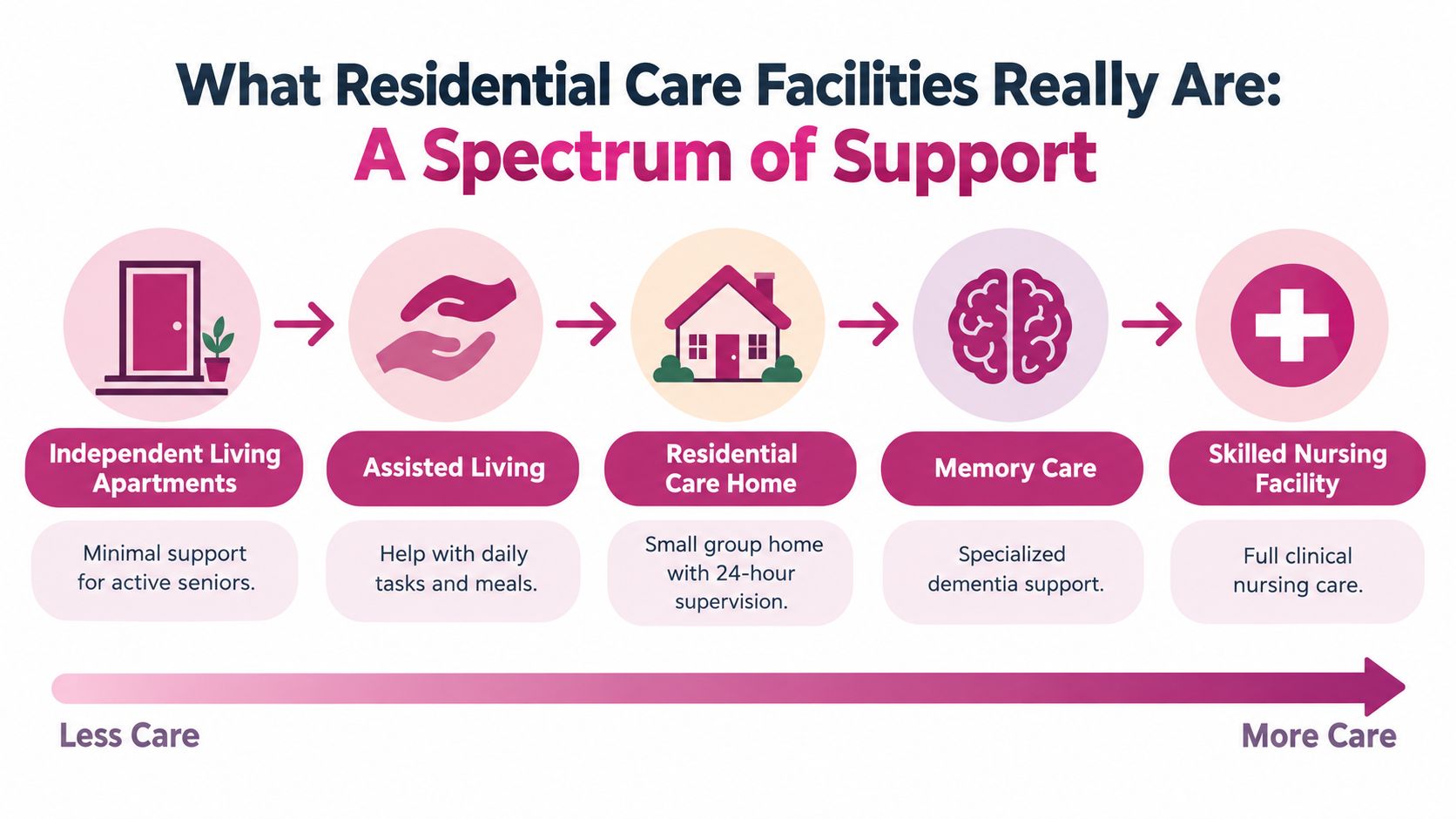
A family may start by looking for a safer version of home. That is the right instinct. Residential care facilities sit in the middle of the senior care spectrum, where daily support is available, but the setting is still more like housing than a medical unit.
On one end are independent living apartments, which offer convenience and social connection with little hands-on help. On the other end is a skilled nursing facility, where clinical care drives the environment. Residential care bridges those two worlds. It gives older adults support with everyday tasks while preserving a more home-like rhythm.
Where they sit on the continuum
Residential care communities are now a major part of long-term care in the U.S. By 2022, the CDC reported 32,200 communities, 1,313,600 licensed beds, and 988,800 residents on a given day, with 81.5% for-profit (CDC FastStats). That scale matters because it shows these settings are not a fringe choice. They are a standard part of the care path families compare.
The same CDC reporting series also shows how the sector has changed over time. In 2010, it counted 31,100 residential care facilities, 971,900 beds, and 733,300 residents, and about half of facilities had only 4 to 10 beds. That older profile helps explain why many families still picture small homes, even though the category now includes larger communities too.
Who they usually serve
These communities fit older adults who need help with daily activities but do not require round-the-clock skilled nursing treatment. The residents may need support with meals, bathing, dressing, reminders, or supervision, yet still want something warmer and less clinical than a nursing unit.
Quality is more than licensure. Families should also ask how the staff prevent infections, whether staffing stays steady enough to know residents well, and how the community handles loneliness or other unmet social needs. A place can meet basic rules and still fall short if people feel rushed, isolated, or unseen.
For a plain-language overview of a closely related option, this complete guide to assisted living for families explains where assisted living overlaps with residential care and where it differs.
Inside Daily Life and Services Offered
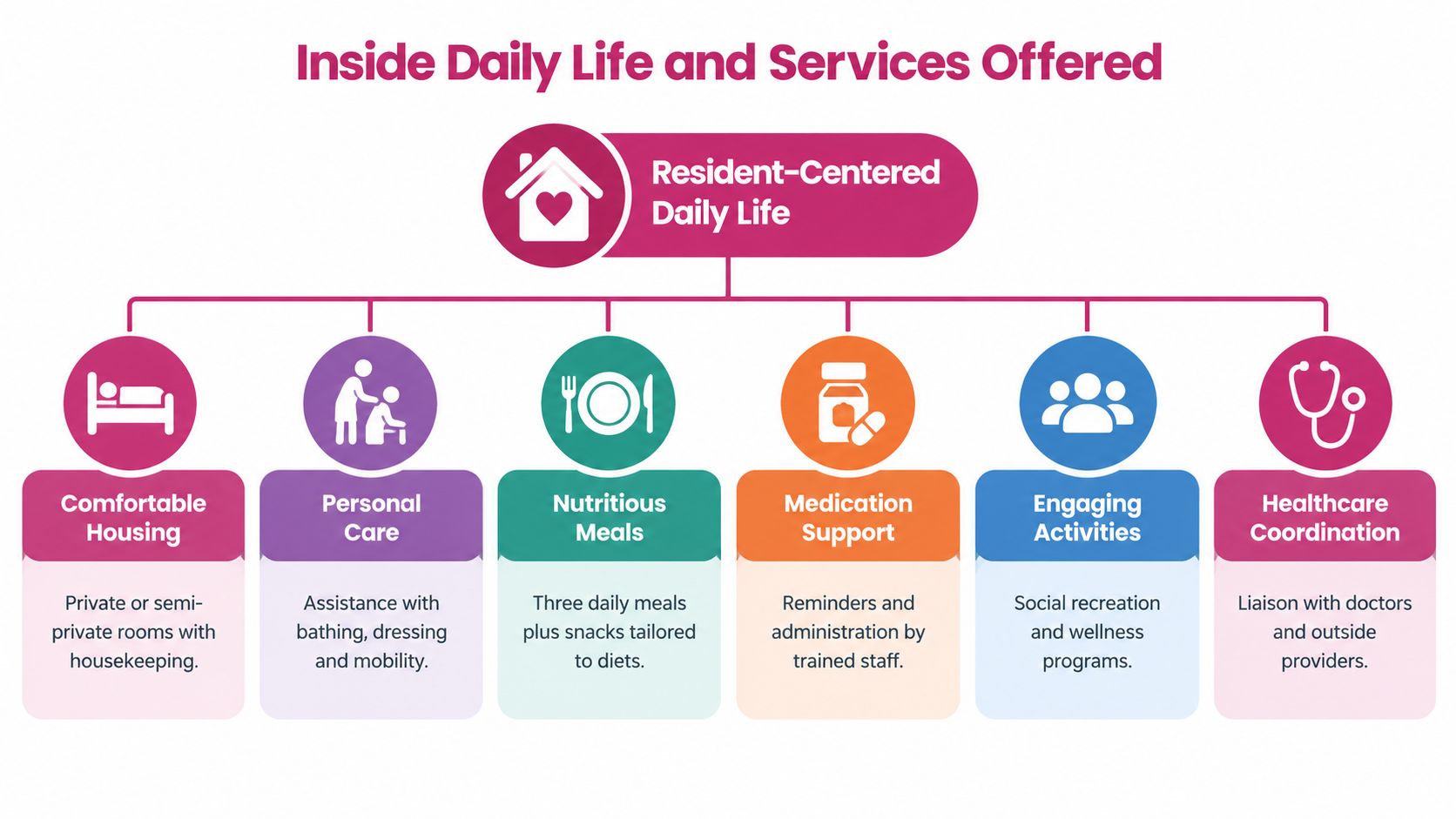
A typical day in a residential care setting is built around ordinary life, not hospital routines. Residents wake up in a room that may be private or shared, get help if needed, eat regular meals, and join activities when they want to. The goal is steady support without stripping away choice.
What the day usually includes
Housing is the starting point. Residents may have a private or semi-private room, and staff usually handle housekeeping and common-area upkeep so the person doesn't have to manage the whole household alone.
Personal care is the next layer. That can mean help with bathing, dressing, grooming, walking, or getting from bed to a chair. These tasks may sound small on paper, but they're often the difference between staying safe and starting the day already tired.
Meals matter more than many families expect. In these communities, dining is not just food delivery, it's also routine, supervision, and social connection. A well-run setting pays attention to appetite, diet needs, and the social value of sitting down with other people.
Medication support also needs close attention. Some residents need reminders, while others need staff to administer medication. Families should ask exactly what the staff handles, what remains the resident's responsibility, and how changes get documented.
Ask this on every tour: who notices when a resident's routine changes first, staff, family, or the resident themself?
What to look for in the rhythm of the place
Activities are the part that often gets treated as optional, but they matter. Social programs, games, music, and simple wellness activities help the day feel like a life, not a waiting room. If a community only lists activities on a calendar but the residents don't seem involved, that's a red flag.
Healthcare coordination is the final piece. Residential care communities often work with outside doctors, therapists, and pharmacies rather than replacing them. Families should expect clear handoffs, not guesswork, because the setting should support care coordination, not create another layer of confusion.
For a practical checklist of what should appear in a service list, the services you should expect from senior living communities article is a helpful companion.
The video below can also help families visualize how daily support feels in real life.
How Residential Care Fits Into the Senior Care Continuum
Different care settings solve different problems. A person who still shops, cooks, and manages medicine may want independence with a little help. A person who needs reminders, supervision, and daily personal care needs something more structured. The fit depends on how much support is required and how much autonomy still feels realistic.
| Care Option | Support Level | Best For | Key Limitation |
|---|---|---|---|
| Independent Living | Light support | Active seniors who want fewer chores and more convenience | Not designed for daily personal care or supervision |
| Residential Care Facilities | Moderate support | Older adults who need help with daily routines, meals, and oversight | Usually not built for advanced medical treatment |
| Memory Care | Higher support for cognitive needs | People with dementia who need structured supervision and cueing | Less freedom and more specialized routines |
| Nursing Homes | Clinical support | People with serious health needs or rehabilitation needs | More institutional and less home-like |
| Home Care | Flexible support at home | Seniors who want to remain at home with scheduled help | Doesn't solve housing, isolation, or 24-hour oversight |
How to use the spectrum without getting lost
Families often compare the wrong things. They ask whether a place looks nice, when the better question is whether the setting matches the person's day-to-day reality. A charming apartment doesn't help if the person forgets meals, while a highly clinical setting may feel too heavy if the main need is routine support.
Aging in place can still work for some families if the home can be adjusted and help can be scheduled well. Resources like the aging in place remodeling playbook are useful when the question is whether the house itself can become safer and more manageable. If the home can't absorb the extra care, then the choice shifts toward a residential setting.
When the boundary starts to blur
Residential care and assisted living are sometimes used as if they mean the same thing, but families should still ask what level of support is available on site. Some communities lean more social and residential, while others support people with heavier care needs. The label alone won't tell you whether the fit is right.
The decision point is usually this, can the person live safely with the level of help the setting is built to give? If the answer is no, it's time to look one step higher on the care continuum instead of hoping the current setting stretches indefinitely.
Licensing Quality Markers and What to Check on Tours
A polished lobby doesn't tell you much. A tour should feel more like checking the plumbing, the staffing, and the daily rhythm than admiring the décor. The best clues are often visible in the first ten minutes if you know what to watch for.
Start with licensing, staffing, and infection prevention
Licensure is the floor, not the finish line. Make sure the community's license is current and ask whether inspection reports are available. After that, watch staff responsiveness. If residents call out and nobody seems to notice, the building may be pretty, but the care system is thin.
Infection prevention deserves more attention in residential settings than many families expect. An evidence review of residential care settings identifies dedicated IPC-trained staff, defined surveillance and monitoring, education and training, standard and transmission-based precautions, outbreak response, and antimicrobial stewardship as core elements (University of Melbourne evidence review). That matters because smaller settings often share bedrooms or bathrooms, which can make it harder to separate illness quickly when staff aren't trained to catch it early.
Clean surfaces are good. Trained people who know how to separate exposures early are better.
Ask about process, not just promises
A clinical review on long-term residential care recommends watching staffing intensity and process indicators, including a full-time staff-to-user ratio benchmark of 0.25 for independent users and 0.35 for assisted users, plus routine tracking of pneumonia incidence density, oxygen therapy use, hospital referrals, antibiotic initiation within 8 hours of diagnosis, and mortality (PMC clinical review). You don't need to calculate those ratios yourself, but you should ask whether the community measures anything similar and how often it reviews outcomes.
A simple tour checklist helps:
- Licensure and records: Ask to see the current license and recent inspection findings.
- Staff visibility: Notice whether staff are present, calm, and easy to find.
- Infection control: Look for hand hygiene supplies and ask who leads outbreak response.
- Care planning: Ask how care plans are updated when a resident's needs change.
- Resident atmosphere: Watch whether people are engaged, respected, and known by name.
If the answers are vague, that's a signal. Good communities usually have clear processes, because good care depends on systems, not just goodwill.
Real World Examples and When to Consider a Higher Level of Care
A widow moves into a residential care community because she wants help with meals and reminders, plus a little company at dinner. For a while, it works well. Then she starts skipping activities, complaining of fatigue, and needing more help getting around, which tells her daughter that the original fit may be changing.
That kind of shift is common. The category keeps absorbing people with more complex needs, especially in assisted living and memory care settings, and families can't assume a move that made sense last year still makes sense now. A room that once felt supportive can become too light on supervision or too limited for a person's cognitive decline.
One often-missed issue is unmet need that isn't strictly medical. A scoping review of 40 studies found 308 unmet-need instances across physical, psychological, social, and environmental domains, with social and physical needs making up the largest shares, and it also found clear regional variation in which needs were most common (Springer scoping review). That's a strong reminder that a licensed community can still leave gaps in loneliness, emotional support, or environmental fit.
Signs the setting may no longer be enough
- Memory loss is creating safety risks: Repeated confusion, wandering, or disorientation usually means the person needs more structured cueing.
- Medical needs are accelerating: More frequent transfers, oxygen use, or repeated respiratory problems suggest the care level may need to rise.
- The person is withdrawing socially: Isolation can be as serious as a physical decline, especially when it changes appetite, mood, and cooperation.
- Daily tasks are multiplying: When the list of helps keeps growing, a community built for lighter support may no longer match reality.
Families often ask when assisted living is no longer enough. A practical answer is that the move higher usually becomes obvious when the person's safety, cognition, or medical complexity starts outpacing what the staff can realistically manage in that setting. The earlier the reassessment happens, the more control the family keeps over the transition.
Finding the Right Fit With Confidence in New Jersey
Residential care facilities make sense when a person needs daily support, but not full nursing-home-level care. The safest choice is usually the one that matches current needs, leaves room for change, and has clear quality systems behind the warm marketing language. For New Jersey families, that means narrowing options by license, support level, and how well the community handles tours and move-in planning.
If you want help sorting the options, a senior placement services guide can be useful as you compare communities, ask about availability, and prepare for an in-person visit. The point isn't to find the fanciest place, it's to find the place that fits the person's real day.
Life Senior Placement helps New Jersey families compare licensed senior living options, including residential care, assisted living, memory care, nursing homes, independent living, and home care. If you're trying to decide what level of support makes sense next, visit Life Senior Placement to start a guided search and move forward with clearer options.