
A continuing care retirement community is a senior living campus that bundles independent living, assisted living, and skilled nursing under one contract, so residents can move between care levels without relocating. In the United States, this is a long-standing model with estimates ranging from about 275 communities serving roughly 90,000 older adults in an earlier benchmark to 1,851 CCRCs in 2019, which shows a mature category that has expanded gradually rather than appearing overnight.
If you're reading about CCRCs, you're probably in the stage where every brochure starts to sound alike. One community talks about dining and fitness. Another talks about peace of mind. A third calls itself a life plan community, which is usually the same basic idea with a newer label.
The confusing part isn't the lobby or the floor plan. It's the promise behind the contract. Families often think they're choosing an apartment, but they're really choosing a long-term care arrangement, one that may shape where a parent lives, how future care is accessed, and how much financial flexibility the family keeps later.
The Short Answer for Families Starting Their Search
Your mother is comparing two attractive campuses. Both offer restaurant-style dining, activities, and a private apartment. One is mainly a place to live today. The other is also a plan for where care may happen later. That second model is what families are usually asking about when they ask, what is a continuing care retirement community.
A continuing care retirement community, often shortened to CCRC and often marketed as a life plan community, is a senior living campus built to serve residents across more than one stage of aging. The simple version is this: a person moves in while still fairly independent, and the community is structured to provide access to more support later if health needs change. The contract matters as much as the apartment, because the purchase is not only housing. It is future access.
That distinction helps clear up a common misunderstanding. Families often compare a CCRC to assisted living because both serve older adults. A CCRC usually starts earlier. It is closer to buying a home and a backup plan in one package.
Industry groups describe CCRCs as communities that combine housing with a continuing agreement for care over time, usually under terms that last longer than a short-term rental and include access to higher levels of care on the same campus or within the same organization, as explained by LeadingAge's overview of life plan communities.
What makes a CCRC different
Three traits usually separate a CCRC from other senior living options:
- More than one care level in one community. A resident may begin in independent living, then shift to assisted living or nursing care if needed.
- A contract built around future care access. The agreement covers more than rent and meals.
- Aging in place as a planned path. The goal is to reduce the chance of a disruptive move during a health change.
Here is the plain-English filter many families find useful. Ask, "Are we choosing a residence only, or are we also reserving a place in line for later care?" If the answer is housing only, it may be a good senior living community, but it is not operating like a classic CCRC.
This is also where market reality matters. The promise of aging in place sounds broad, but the value depends on what kind of care the campus has room to provide, how that access is prioritized, and what the family pays now versus later. In other words, a CCRC is not just a lifestyle choice. It is a tradeoff between flexibility, predictability, and cost.
A helpful comparison is a travel plan with built-in rebooking rights. Two trips may start at the same airport and even cost a similar amount at first glance. The difference shows up when plans change. CCRCs work the same way. The appealing lobby matters less than what happens if a resident needs more help five years from now.
If you are still sorting out the wider senior living field, this guide to senior living homes by care type and location can help you separate CCRCs from options that look similar at first glance.
How CCRC Contracts Actually Work
A family tours two beautiful communities on the same afternoon. Both have bright dining rooms, activity calendars, and apartments that feel easy to picture as home. Then the contracts come out, and the difference appears. One community is selling more future cost protection. The other is selling housing now, with more charges added later if care needs change.
That is the part many families miss.
A CCRC contract has two layers. The first layer is the residence itself. The second is the financial agreement for future care. You can compare it to buying a car with different warranty levels. The car may look similar on the lot, but the value changes once repairs are needed.
The three common contract styles
Type A, often called life care, usually asks for a higher entrance fee and often a higher monthly fee. In return, much more of the cost of future assisted living or skilled nursing care is built into the contract. Families often choose this version when they want fewer cost surprises later.
Type B, often called a modified contract, splits the difference. It may include a set number of days of higher care, or it may offer that care at a discounted rate for a period of time. After that limit is reached, the resident may pay more.
Type C, often called fee-for-service, generally has a lower initial financial commitment compared with other CCRC contract types. The tradeoff is that if the resident later needs more care, those charges are more likely to show up separately and rise with use.
| Feature | Type A (Life Care) | Type B (Modified) | Type C (Fee-for-Service) |
|---|---|---|---|
| Basic idea | Prepays more future care | Mix of prepaid access and later charges | Pays separately for more care when needed |
| Up-front commitment | Often higher | Often mid-range | Often lower relative to other CCRC contracts |
| Monthly fee pattern | Usually steadier when needs increase | May rise after included services are used | More likely to rise with higher care use |
| Who often prefers it | Planners who want predictability | Families balancing predictability and flexibility | Residents prioritizing lower initial commitment |
What the contract is really shifting
The key issue is who carries more of the future care cost risk.
With a stronger Type A contract, the community takes on more of that risk because the resident has prepaid more for later care access. With a Type C contract, the resident keeps more of that risk because later care is billed more directly when it is needed. State consumer disclosure guides commonly describe CCRCs in these terms because the contract is not only about where someone lives. It is also about who is more exposed if health changes over time, as explained in the New Jersey Department of Community Affairs guide to continuing care retirement community contracts.
That may sound technical, but families usually feel it in very practical ways.
- A parent who says, "I want to know I can stay here even if my health changes," is often reacting to risk, not décor.
- A couple trying to protect more savings early may accept more uncertainty later and look harder at Type B or Type C.
- An adult child living in another state may care less about granite countertops and more about how the contract handles a sudden need for higher care.
The plain-English decision framework families can use
Start with three questions.
First, what are you prepaying for?
Some contracts mainly prepay for priority access. Others prepay for a meaningful share of the care itself.
Second, how much later cost variability can the family absorb?
A lower entrance fee can feel safer at first. It may be safer. Or it may postpone the larger bill to the years when more care is needed.
Third, does the campus have the capacity to deliver the promise behind the contract?
Aging in place sounds reassuring, but the value depends on whether the community has enough assisted living and skilled nursing availability for its residents, and what priority current residents receive when those units are needed.
This is why price comparisons often go wrong. Families compare monthly fees as if they were comparing rent. In reality, they are often comparing different mixes of insurance-like protection, future access rights, and pay-later exposure.
Questions to ask before you compare prices
The headline fee only gives part of the picture. Ask each community:
- What care is included now, and what specific event triggers a higher charge later?
- Is the entrance fee refundable, partially refundable, or nonrefundable?
- How do monthly fees change if the resident moves to assisted living or skilled nursing?
- What priority do current residents get if a higher-care unit is needed?
- What happens if one spouse needs a higher level of care before the other?
The most useful contract question is not "What does this cost today?" It is "What does this cost if health changes in three, five, or eight years?"
Families often fall in love with the apartment first. A calmer approach is to compare the contract terms, the refund rules, and the later-care pricing before judging the floor plan.
The Continuum of Care on One Campus
A family often understands a CCRC only after they picture an actual move. A parent may start in an apartment or cottage, living much as they do now, then step up to more support only if health changes. The appeal is simple. Home base stays familiar while the care setting changes.
Margaret shows how that usually works.
Margaret moves into a cottage at age 78. She still drives, cooks for herself, and spends more time choosing lecture programs than thinking about healthcare. That stage is independent living. She has her own residence, neighbors around her age, shared amenities, and fewer home-maintenance chores.
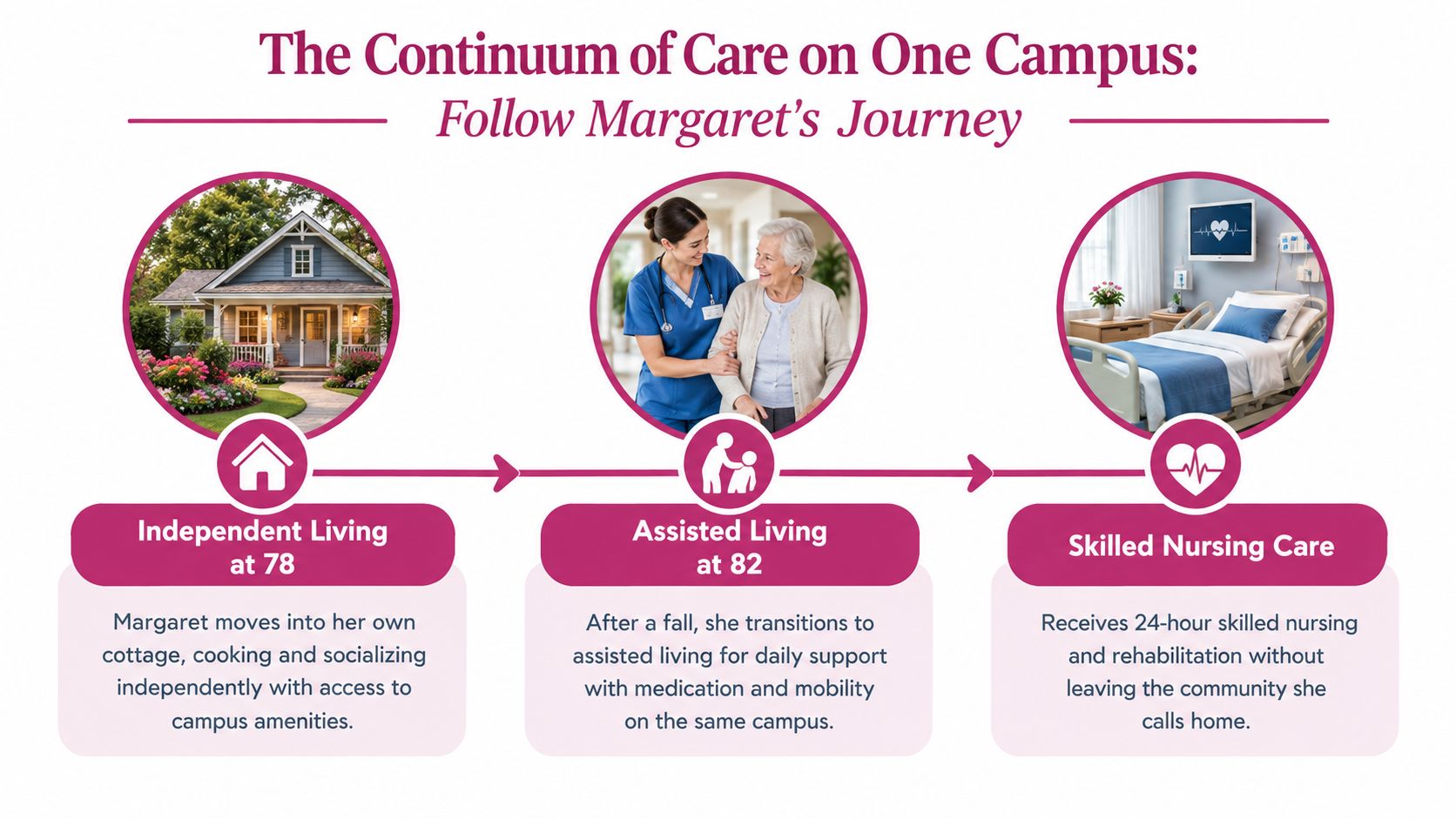
A few years later, Margaret has a fall. She is still mentally sharp, but dressing, bathing, and managing medications now require more help than she can safely handle alone. She moves to assisted living on the same campus. Her mailing address may change inside the community, but much of daily life still feels familiar. Staff may already know her routines. Friends can still visit without a long drive.
At 86, she has a stroke. She now needs around-the-clock nursing oversight and rehabilitation. That level is skilled nursing. In a CCRC, the goal is to avoid a rushed search across town because the next care setting is already part of the same community.
What each care level means
Families new to senior living often hear these terms as if they are interchangeable. They are not. They describe very different kinds of help.
- Independent living: Housing for older adults who do not need daily hands-on care.
- Assisted living: Help with everyday tasks such as bathing, dressing, medication management, or mobility.
- Skilled nursing: Clinical care for people who need licensed nursing supervision, rehabilitation, or both.
Some campuses also include memory care for residents living with dementia-related needs.
This short overview can help you visualize how the transitions work in real life:
What "one campus" does and does not guarantee
The phrase aging in place can sound like a promise that every future care need will be easy to meet. A better way to view it is as a system with several doors. The doors may all be on the same property, but a resident still needs the right door to be open at the right time.
That is where families should slow down and separate marketing language from actual access. A campus may offer independent living, assisted living, memory care, and skilled nursing, yet those areas can have very different availability. Skilled nursing is often the tightest part of the system. Memory care may be limited to a small neighborhood. Assisted living may have only a modest number of units compared with independent living.
Industry researchers often describe CCRCs as the most vertically integrated form of senior housing because multiple care settings are combined under one organization and campus model, as explained in the American Seniors Housing Association overview of continuing care retirement communities. For families, that matters only if the structure translates into real access when health changes.
So the practical question is not just, "Do you offer higher levels of care?" Ask, "How many units are there at each level, and what happens if my parent needs one when it is full?"
Ask one direct question on every tour: "If my parent needs the next level of care, how is that transfer handled when that part of the campus is full?"
That answer usually reveals more than the brochure.
Benefits and Tradeoffs Most Families Miss
A common family scenario goes like this. Dad likes the apartment, Mom likes the idea of staying in one community, and everyone feels relieved by the phrase "aging in place." Then questions show up. How much cash gets tied up at the start, what happens if care needs change faster than expected, and how much access is the family buying?
Those questions matter because a CCRC is not just a housing choice. It is also a financing choice and, in many cases, a bet on future access.
The benefit families feel first
The biggest appeal is reduced decision fatigue. Instead of solving housing, support, and possible future care as separate problems over several years, a family can place much of that planning under one contract. For an older adult who wants stability, that can feel like buying a long-term travel pass instead of paying for each ride one at a time.
That convenience has a price.
Many CCRCs ask for a large entrance fee plus monthly charges. The trade is straightforward. You may get a clearer path into higher care later, but you are committing more money earlier, often before you know how much of that later care your parent will use.
The tradeoff families often underestimate
The promise sounds simple: pay now, worry less later.
The fine print is more practical than simple.
A family should separate three different questions:
- Liquidity: How much money is tied up in the entrance fee, and how quickly is any refund paid if the resident moves out or dies?
- Pricing risk: How much can monthly fees rise over time, and are higher care services partly included or billed at market rates?
- Access risk: Does the contract provide priority for the next care level, or a stronger form of access with predictable pricing?
Those are different risks. A community may look strong on one and weaker on another. For example, a contract with a high entrance fee may reduce future care rate shock, while a lower-entry option may preserve assets today but leave the family paying more later if care needs increase.
What current market conditions mean for buyers
High demand can be reassuring. It suggests the model still appeals to many older adults.
High demand also gives families less room for error.
Analysts at NIC said 2026 occupancy is expected to keep rising, while annual rate growth for independent living, assisted living, and memory care is projected to be around 4% to 4.5%, with supply growth remaining limited, according to NIC's 2026 outlook for U.S. Continuing care retirement communities.
In plain English, that creates a decision framework families can use:
| If you value this most | The tradeoff to examine closely |
|---|---|
| Staying in one system if health changes | You may need to commit substantial assets before those future services are needed |
| More predictable long-term budgeting | Predictability depends heavily on contract type and how fee increases are handled |
| Priority compared with starting over elsewhere | Priority is not the same as immediate availability in every care segment |
| A strong social setting and fewer household burdens | You may pay for layers of the model your parent never uses |
Capacity and fees should be discussed together
Families often ask about care levels and pricing as if they are separate topics. They are connected.
Here is why. The more a family is paying up front for future stability, the more important it is to test where access could tighten. Recent NIC reporting on CCRC performance pointed to continued demand for memory care while some nursing inventory remained under pressure, which is a reminder that demand does not rise evenly across every care segment at the same time, as discussed in NIC's 2Q 2026 CCRC performance analysis.
That does not mean a CCRC is a poor choice. It means families should compare the promise of aging in place against the parts of the campus that are most likely to feel crowded or costly later.
A good tour question brings both issues together: "If my parent moves from independent living to a higher level of care, what changes in monthly cost, and what happens if that care setting is full?"
One answer reveals more than a polished brochure because it tests the two pressure points many explainers skip. Money committed today, and access available later.
How CCRCs Compare to Other Senior Living Options
A daughter tours a bright senior campus with her mother on Saturday, then spends Sunday looking at home care agencies and a local assisted living building. By Monday, all three options can sound like they promise the same thing. Support now, help later, less stress for the family.
They are not the same purchase.
The clearest way to compare them is to ask three plain-English questions. Are you paying mainly for housing and today's help, or also for future access? If health needs change, does your parent stay put or face another move? And who does the coordination work. The community, or the family?
Side-by-side comparison
| Option | Care Coverage | Relocation Risk | Typical Cost Structure |
|---|---|---|---|
| CCRC | Designed to connect independent living with assisted living, memory care, and sometimes skilled nursing on one campus | Often lower, but only if the contract terms and care capacity line up when needs change | Entrance fee plus monthly fees, with structure varying by contract type |
| Standalone independent living | Housing, meals, activities, and convenience services, but little or no hands-on care | Higher if health needs increase beyond what the building can support | Monthly housing and service fees |
| Standalone assisted living | Help with bathing, dressing, medication reminders, and daily routines, but not always a built-in path to later care levels | Moderate to high if needs progress beyond assisted living | Monthly fee with added charges for care services |
| Aging at home with hired caregivers | Can be adjusted over time, but the family usually manages scheduling, supervision, and backup plans | The address stays the same, but care can become harder to organize as needs grow | Home costs plus private-pay support services |
A simple way to read this table is to compare bundled planning with pay-as-you-go planning.
A CCRC works more like buying into a long-term system. You are not just choosing an apartment. You are also buying rules about what happens if your parent later needs more help, and those rules matter as much as the floor plan. Other models are usually more flexible at the start, but they may require the family to rebuild the plan later, one stage at a time.
When each option tends to fit best
Standalone independent living often makes sense for an older adult who is still fairly independent and mainly wants community, meals, transportation, and fewer home chores. The tradeoff is simple. If care needs rise, the family may need to arrange the next move.
Standalone assisted living often fits someone who needs daily support now and does not want to pay an entrance fee for future care access that may never be used. If you want a clearer baseline for that model, this guide on what assisted living means for families explains what assisted living usually includes and where its limits begin.
Aging at home often feels emotionally easiest at first because the house is familiar. In practice, it can become the most management-heavy option. Someone has to hire aides, cover call-offs, monitor safety, and keep adjusting the plan as needs change.
A CCRC often fits families who want one setting with a built-in path for later care and are comfortable committing more money up front to reduce the odds of scrambling later. That promise is strongest when the contract is clear and the care levels your parent is most likely to need have real availability, not just a place on a brochure.
A practical filter for family decisions
Use these questions the way you would use a map legend. They help you tell similar-looking options apart.
- Choose a CCRC if: your parent wants one long-range plan, has the assets for entrance and monthly fees, and your family places high value on having later care connected to the same campus.
- Choose independent living if: the main goal is lifestyle, social connection, and relief from home maintenance, without paying for the largest all-in-one contract.
- Choose assisted living if: help with daily life is needed now, and the family is comfortable making later higher-care decisions if health changes again.
- Choose home care if: remaining at home is the top priority, the house can stay safe, and the family can handle staffing, oversight, and backup coverage.
Many families do not need the most bundled model. They need the model they can afford, understand, and keep running without constant reworking.
If your comparison is starting to include estate protection, Medicaid timing, or future skilled nursing exposure, this overview of nursing home cost planning in Texas adds legal context that can sit alongside the housing decision.
Evaluating a CCRC Before You Sign
Tour days are designed to be reassuring. Contract review days are where the decision happens.
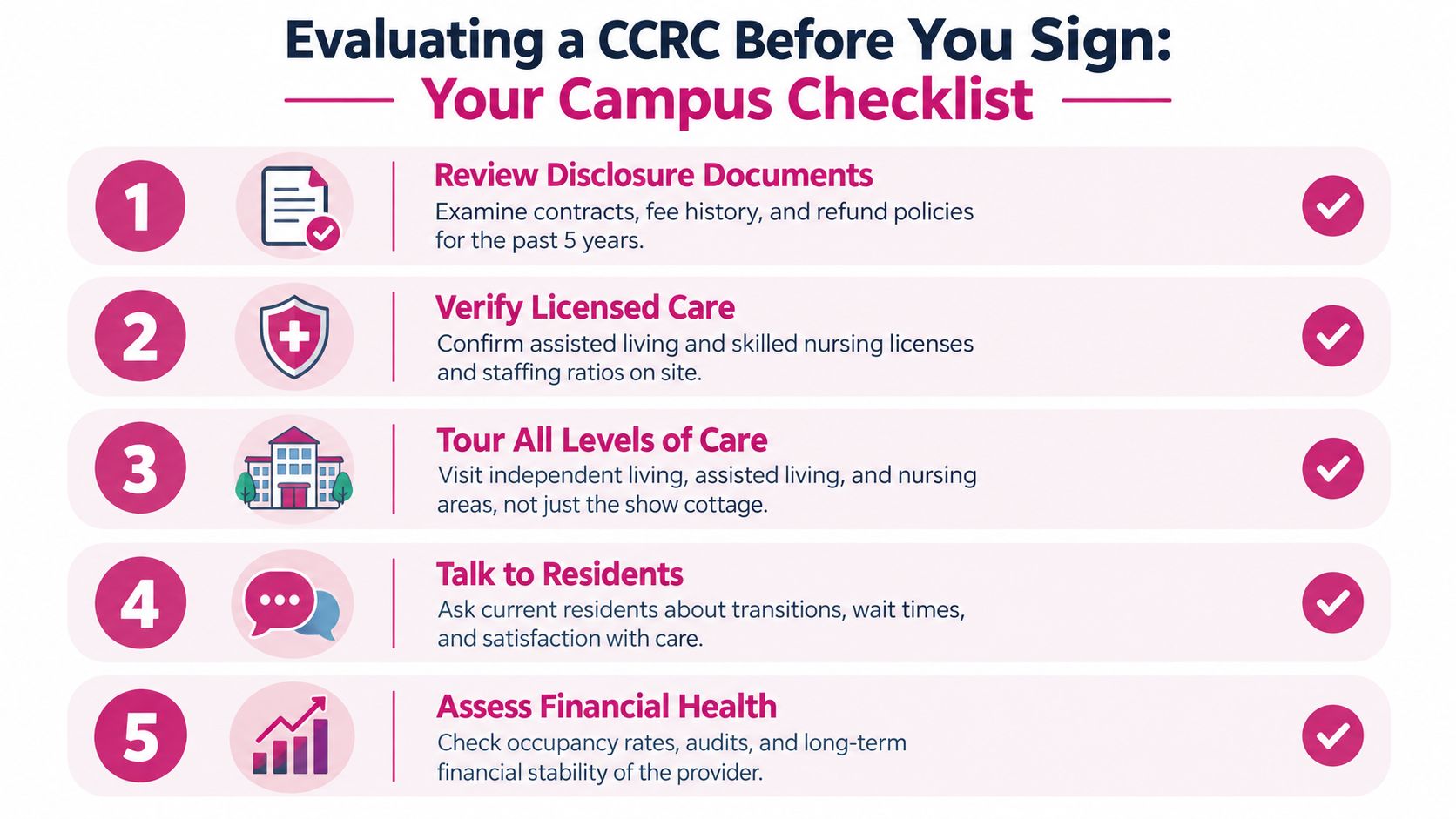
The safest approach is to evaluate each CCRC in the same order every time. Start with paper, move to care capacity, then test what residents experience.
Start with documents, not décor
Ask for the disclosure statement, the full residency contract, and the fee schedule. Then read for three pressure points:
- Refund policy: Is the entrance fee refundable, partly refundable, or not refundable?
- Monthly fee changes: How have fees changed over recent years?
- Transfer terms: What happens if the resident needs assisted living, memory care, or skilled nursing?
A practical supplement is a list of questions to ask at every assisted living and senior living tour, especially if you're comparing campuses with different care models.
Verify care access at each level
Don't stop at overall occupancy. Ask what the current availability looks like in independent living, assisted living, memory care, and skilled nursing separately. A campus can feel open in one area and constrained in another.
Ask these questions plainly:
- How often do residents wait for transfers between levels of care?
- If the skilled nursing unit is full, what happens next?
- Are outside caregivers allowed in independent living?
- How are couples handled when one spouse needs more care?
Residents often tell you the part brochures don't. Ask whether transitions felt smooth, delayed, or more expensive than expected.
Tour beyond the showcase apartment
Visit every level of care, not just the independent living model unit. The dining room and lobby may be polished while the higher-care wings feel very different.
If a move is likely, practical downsizing work matters too. A room-by-room downsizing guide for preparing a senior move can help families sort what to keep, donate, store, or move before a unit opens.
One more practical option belongs on the shortlist. A placement service such as Life Senior Placement can help families compare independent living, assisted living, memory care, nursing homes, and home care options side by side when they're still unsure whether a CCRC is the right category.
Is a CCRC the Right Fit and What to Do Next
A CCRC usually fits best when the family wants to solve tomorrow's care problem before it becomes urgent. That's very different from shopping only for today's apartment.
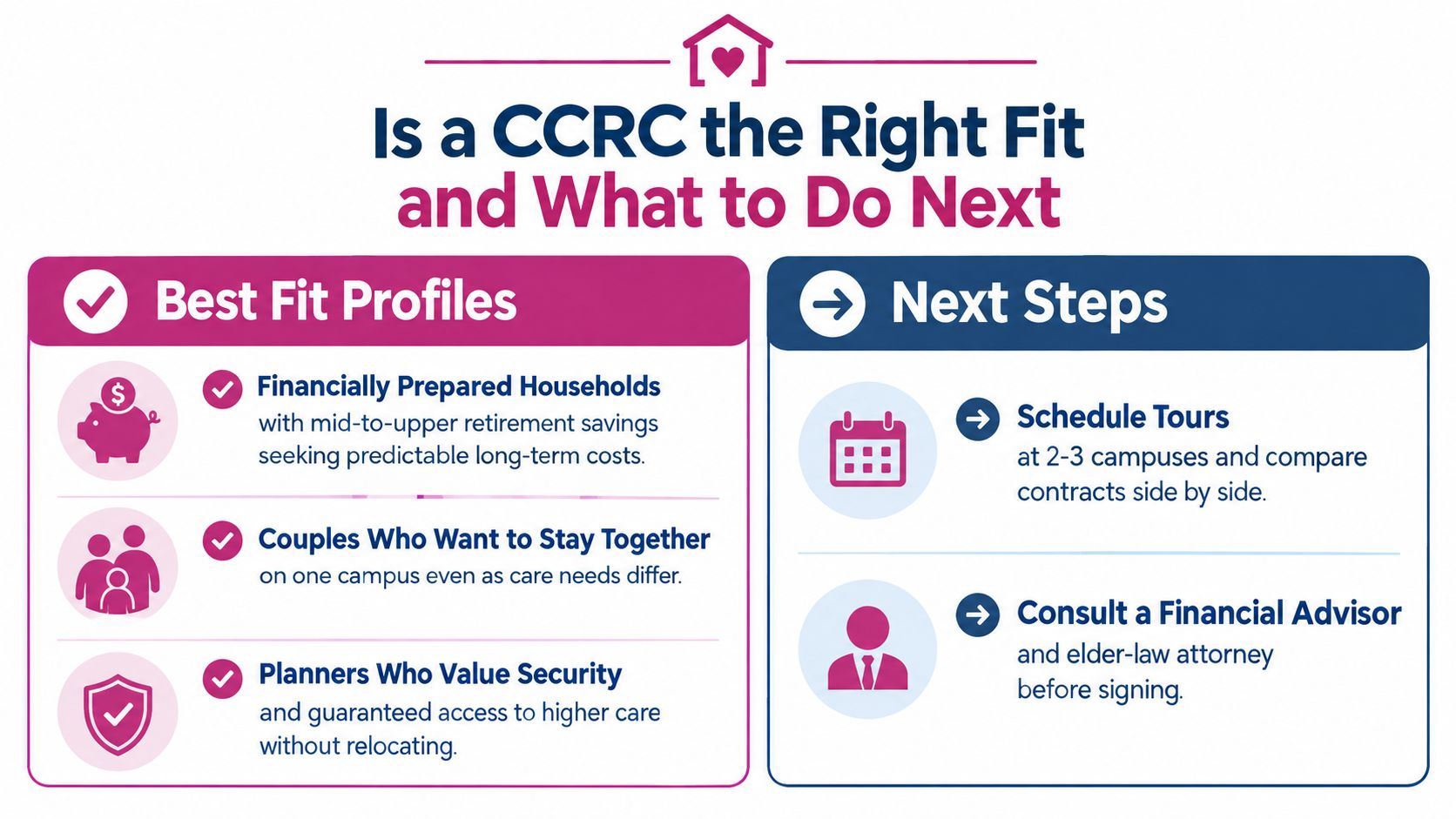
The strongest fit is often a household that can comfortably fund a larger up-front commitment, values staying on one campus, and wants a more predictable plan if health changes. Couples often see the appeal quickly. One spouse may stay more independent while the other needs more support, and the broader community connection can remain intact.
Who tends to benefit most
A CCRC often makes sense for:
- Long-range planners who care more about future stability than maximum liquidity.
- Adult children at a distance who want fewer emergency decisions if a parent's needs increase.
- Couples with uneven health trajectories who may need different support levels over time.
- Socially motivated older adults who want community life, amenities, and a clearer care ladder.
Who may want a different route
A different option may be better for:
- Renters or budget-sensitive households that don't want a large financial commitment tied up in entrance and monthly fees.
- People who need immediate high-level nursing care rather than a future-oriented campus plan.
- Families who prefer flexibility and don't mind coordinating care in stages as needs evolve.
What to do next
Keep the next steps simple and concrete:
- Ask the doctor for a realistic health outlook: Not a perfect forecast, just the likely direction of care needs.
- Request the disclosure statement and fee history: Read the contract before falling in love with the apartment.
- Ask about capacity by care level: Not just whether the campus is "full."
- Visit more than once: Morning and evening visits reveal different rhythms.
- Review the contract with an elder-law attorney or fiduciary advisor: This is a legal and financial decision as much as a housing one.
A good working summary is this: a CCRC trades some financial flexibility today for more housing and care predictability later. Whether that trade is worth it depends less on the brochure and more on your parent's health outlook, finances, and tolerance for future moves.
If you're comparing CCRCs with assisted living, memory care, nursing homes, independent living, or home care, Life Senior Placement helps families narrow the options based on care needs, budget, and location, then coordinate tours and side-by-side comparisons. If you want help sorting which level of care fits your parent before you start visiting communities, visit Life Senior Placement.