
A private nursing home room in New Jersey had a median annual cost of $172,280 in Genworth's 2024 survey, according to Genworth's New Jersey cost-of-care announcement. That figure reframes the question families need to ask. It's not just whether they can afford a monthly payment, but how they'll fund the right support for as long as it's needed.
If you're planning elderly care costs in 2026, treat published survey figures as benchmarks, not current quotes. Your family's budget needs to account for the setting, scheduled care hours, likely duration, and charges outside the advertised rate.
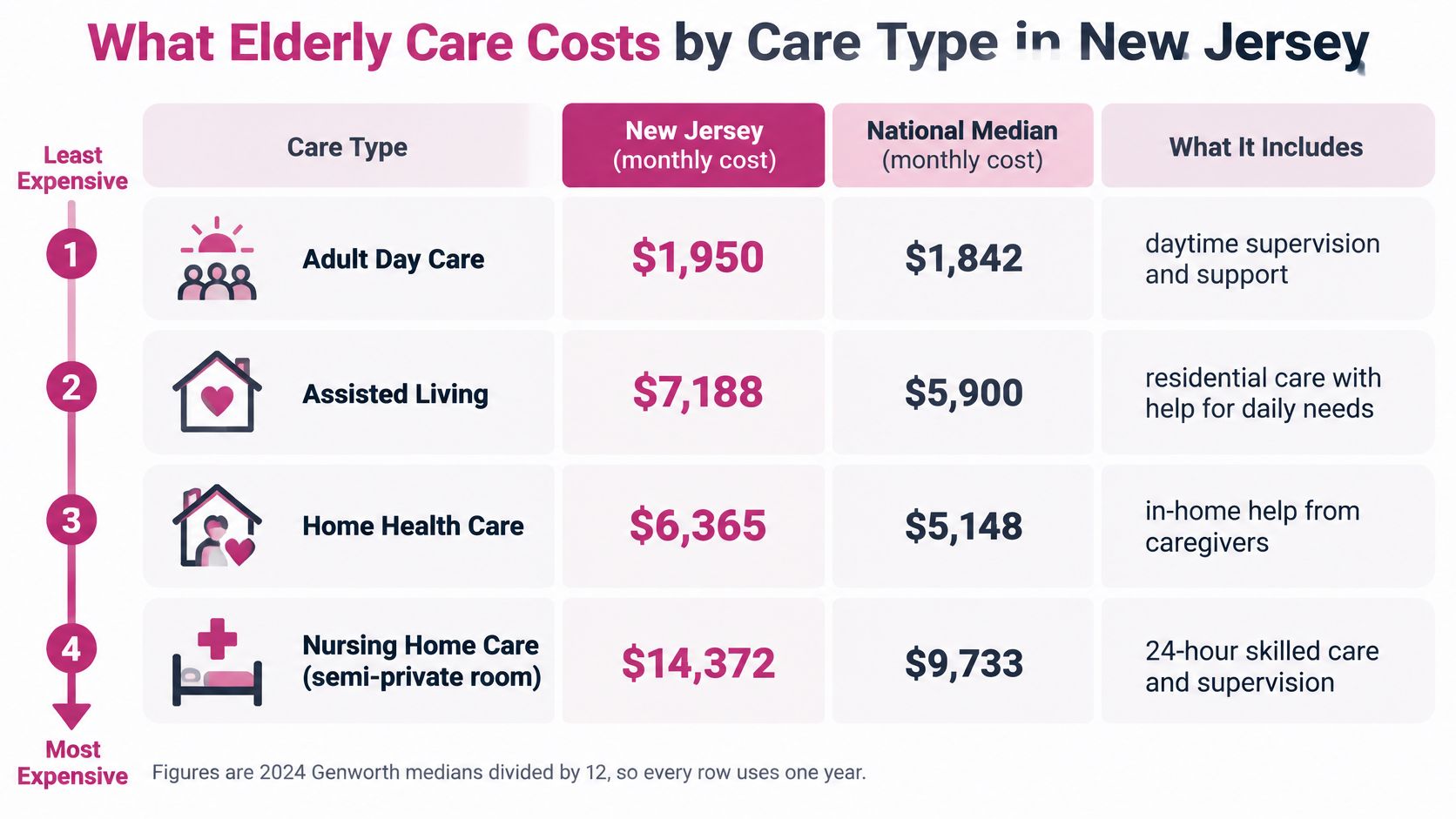
What Elderly Care Costs by Care Type in New Jersey
The New Jersey median for assisted living is $8,710 a month, and a semi-private nursing home room runs $12,775 a month, based on rounded monthly calculations from annual medians in CareScout's New Jersey cost table; the national comparisons use Genworth's 2024 Cost of Care Survey. Independent living and memory care are our placement estimates, not survey medians.
Elderly care costs by care type, New Jersey and national, monthly
| Care type | New Jersey monthly cost | What the price covers |
|---|---|---|
| Independent living | $3,000 to $6,000, our placement estimate; no comparable national figure used | Apartment, dining, and activities, without hands-on personal care |
| Assisted living | $8,710 median; national median $6,200 | Housing, meals, and personal support, subject to the community's care tiers |
| Memory care | $7,200 to $10,800, our placement range; no comparable national figure used | Secured surroundings, higher staffing support, and specialized cognitive programming |
| Nursing home, semi-private room | $12,775 median; national median $9,277 | Round-the-clock nursing and rehabilitation services in a shared room |
| Nursing home, private room | $14,357 median; national median $10,646 | Nursing and rehabilitation services with a private room |
| Home health aide | $7,055 median; national median $6,483 | Scheduled aide assistance at home, based on 44 hours weekly, not continuous coverage |
A median is a midpoint, not a quote. Half of providers charge more, and half charge less. Treat each figure as the first line of the budget: weekly care hours, how long care lasts, and fees outside the base rate fill in the rest.
Read the service description before comparing the price. Independent living is primarily a housing and lifestyle choice. An attractive apartment and meal package don't establish that staff can provide bathing assistance or manage a resident's mobility needs.
Assisted living adds personal support, while memory care addresses cognitive and safety needs through a more specialized environment. Nursing homes provide a clinical level of support that an independent living apartment doesn't offer. The home health aide row needs the same care: $7,055 a month assumes 44 scheduled hours each week, and rent, groceries, and coverage outside those visits still sit on the household's ledger.
The visual offers another comparison of care settings; use the sourced table above for the budget calculations in this article.
Local ranges help narrow the search
State medians don't tell you what an available apartment in your preferred town will cost. Our listings around Lodi show broad monthly ranges of $5,500 to $8,800 for assisted living, $7,200 to $10,500 for memory care, and $3,200 to $5,200 for independent living. Home care around Lodi is listed at $29 to $38 an hour.
These are ranges, not quotes. In Elmer, our independent living range is $2,500 to $4,200 monthly, while assisted living typically runs $4,800 to $7,500 monthly. Apartment amenities and meal packages move the base rate, and advanced personal care or two-person transfers push a resident toward the top of the range, so two residents in the same building can pay very different totals.
Comparison rule: Match the services before comparing the totals. A lower housing price isn't necessarily a lower care budget.
For families considering an aide, Cream Home Care's guide to budgeting for in-home support can help organize questions about scheduling and included services. It isn't a New Jersey rate sheet.
Request a written, individualized price and leave room for future changes. The setting establishes the baseline; the person's actual needs determine the workable option.
How Home Care Hours Change the Monthly Bill
Home care isn't automatically the cheaper choice. It can be economical when a person needs help during limited visits, but much more demanding financially when someone must remain present throughout the day and night.
Our in-home care pricing averages $30 to $38 per hour for licensed non-medical aide assistance. Schedules range from a few hours weekly to full 24/7 care. The important starting point is a realistic schedule, not the smallest package an agency advertises.
Turn a weekly schedule into a monthly budget
Use this calculation:
Weekly hours × weeks in the billing period × hourly rate = scheduled care cost
For the illustrative table below, assume 4.33 weeks per month and our hourly pricing range. Monthly hours are rounded for display, while costs use the unrounded calculation.
Home care monthly cost by weekly hours
| Weekly hours | Hours per month | Illustrative monthly care cost |
|---|---|---|
| 8 hours | 35 | $1,039 to $1,316 |
| 16 hours | 69 | $2,078 to $2,633 |
| 24 hours | 104 | $3,118 to $3,949 |
| 44 hours, the survey benchmark schedule | 191 | $5,716 to $7,240 |
These are worked estimates, not agency quotes. A calendar-month invoice may differ, and minimum shifts or premium periods can change the result. Our guide to how much home care costs can help you organize the comparison.
Find the crossover for your household
Divide a residential community's complete monthly quote by the agency's hourly rate, then divide by the weeks in your planning month. The result estimates the weekly paid hours at which the service prices meet.
That's only a starting point. Add the expenses of maintaining the home, then consider whether relatives can reliably cover the remaining hours. Don't count a working adult child as available just because they live nearby.
For a longer-term perspective, the 2025 Milliman Long-Term Care Index projects costs of more than $665,000 for people requiring care for five years or longer. Duration deserves as much attention as the hourly rate.
Aging at home may be the preferred choice, but preference and affordability need separate calculations.
Before accepting a schedule, clarify overnight arrangements, weekend pricing, replacement coverage, transportation, and any agency charges. Compare complete plans that provide equivalent supervision, not an aide's hourly price against an entire residential package.
Lifetime Cost Risk by Care Duration
A care budget can work comfortably for a short recovery and become unsustainable if the same need continues indefinitely. The useful question isn't, “Can we pay this month?” It's, “What changes if this support becomes permanent?”
Consider a hypothetical New Jersey household whose parent leaves the hospital needing nursing rehabilitation. After recovery, the parent returns home with scheduled help. Later, cognitive changes make a secured memory care setting more appropriate.
Each transition changes the budget. The family may also pay overlapping housing expenses, transportation, moving costs, and deposits while arranging the next setting.
Plan for a sequence, not a single destination
Create separate budget lines for the recovery period, the supported period at home, and any later residential placement. Use the actual expected length of each stage rather than applying one community's monthly rate to the whole future.
| Possible care path | What to estimate | What could change the plan |
|---|---|---|
| Recovery followed by home support | Rehabilitation costs, home preparation, and scheduled aide visits | Recovery takes longer or mobility remains limited |
| Home support followed by memory care | Household expenses, supervision, and eventual relocation | Wandering, nighttime needs, or caregiver availability |
| Direct move into assisted living | Ongoing residential charges and care assessments | The resident later requires a different clinical setting |
Moving directly into assisted living may simplify logistics, but it isn't automatically the least expensive or clinically appropriate path. Staying home may preserve familiar routines, but only if someone can safely cover the necessary hours.
Stress-test the duration. Extend each stage in your planning worksheet and identify which funding source would cover the additional expense. Include the spouse's ongoing living needs rather than treating all household savings as available for care.
A useful plan names both the preferred setting and the fallback. If relatives can no longer provide support, the family should know which alternative is affordable and appropriate before that change becomes urgent.
Hidden Fees That Raise the Final Bill
In Wall, New Jersey, assisted living baseline rates cover housing, dining, and activities, while tiered care fees adjust according to help with medication, bathing, and mobility. That distinction matters: the apartment price and the resident's complete monthly bill aren't necessarily the same.
A resident who needs more physical assistance after moving in may enter a higher care tier. Ask for a personalized assessment before treating the advertised starting rate as your budget.
Ask what sits outside the base rate
Use the written fee schedule to check these potential charges:
- Memory support changes: Ask whether increased wandering or behavioral support changes the rate or requires another setting.
- Transfer assistance: Establish how help from additional staff members is priced.
- Medication management: Separate staff assistance from the cost of prescriptions.
- Personal supplies: Identify responsibility for continence products and other recurring items.
- Appointments and transportation: Check ride availability, escort assistance, and waiting-time charges.
- Clinical services: Clarify therapy, pharmacy, and outside-provider billing.
- Move-in charges: Record community fees, deposits, refund terms, and payment deadlines.
Our explanation of New Jersey assisted living base rates and add-on fees provides a framework for comparing these items.
Understand who controls the price
Each participating organization determines its own pricing structure, not Life Senior Placement. A care-tier label at one community may include different services from a similarly named tier elsewhere.
Request the base rate, every applicable care tier, and the conditions that trigger reassessment in writing. Also request the community's rate-change history and its notice requirements.
Before signing: Ask staff to walk through the bill using your parent's current needs, then explain what would change if those needs increased.
Keep medical spending separate where it's billed separately. A community quote doesn't necessarily replace insurance premiums, copayments, dental expenses, or outside specialist bills.
Medicaid, Insurance and Other Ways to Pay
Start with recurring income, then identify which expenses must come from savings or benefits. An affordable opening month doesn't establish a sustainable funding plan.
The middle-income gap is substantial. KFF's analysis of affordability for people with Medicare reports median beneficiary income of $43,200 and savings of $110,100, alongside a 2025 national median annual cost of $129,575 for a private nursing home room and $305,760 for round-the-clock home health aides.
Those are national figures, not local quotes. They explain why a household can have meaningful resources yet still struggle to fund prolonged care.
Match each funding source to its limits
Ways to pay for elderly care and their limits
| Funding source | What it covers | Main limit |
|---|---|---|
| Private income and savings | Care bills paid from pensions, Social Security, savings, and investments | Withdrawals must leave enough for ongoing household needs |
| Long-term care insurance | Eligible home or facility care under the policy | Coverage must generally be arranged before care is needed; benefit triggers, caps, and waiting periods apply |
| Medicaid | Eligible nursing home care and qualifying home or community-based services | Financial and clinical eligibility, provider participation, and placement availability matter |
| Medicare | Qualifying short-term skilled nursing and eligible home health services | Doesn't fund ongoing custodial care; a qualifying hospital stay applies to some skilled nursing coverage, not all home health |
| Veterans Aid and Attendance | A pension addition for eligible veterans and surviving spouses needing assistance | Service, financial, and care-related requirements apply |
| Reverse mortgage or home sale | Access to home equity | Sale consequences, borrowing costs, occupancy rules, and a spouse's housing needs require review |
Don't treat Medicaid participation as a promise of immediate admission. Confirm whether a community can accommodate the person's care needs, what the resident must pay, and what happens if private funds run out.
Protect the household, not just the care payment
Families may consider spending savings, selling property, or sharing caregiving. Each choice affects someone else's security: a spouse may still need the home, while relatives may sacrifice earnings to provide care.
Before transferring assets or changing ownership, obtain qualified benefits and legal advice. Eligibility planning isn't just a matter of moving money out of an account.
Our guide to paying for assisted living without draining savings can help frame the funding conversation. Confirm Medicaid arrangements before touring if public benefits may be part of the long-term plan.
Build a Budget and Choose a Care Level
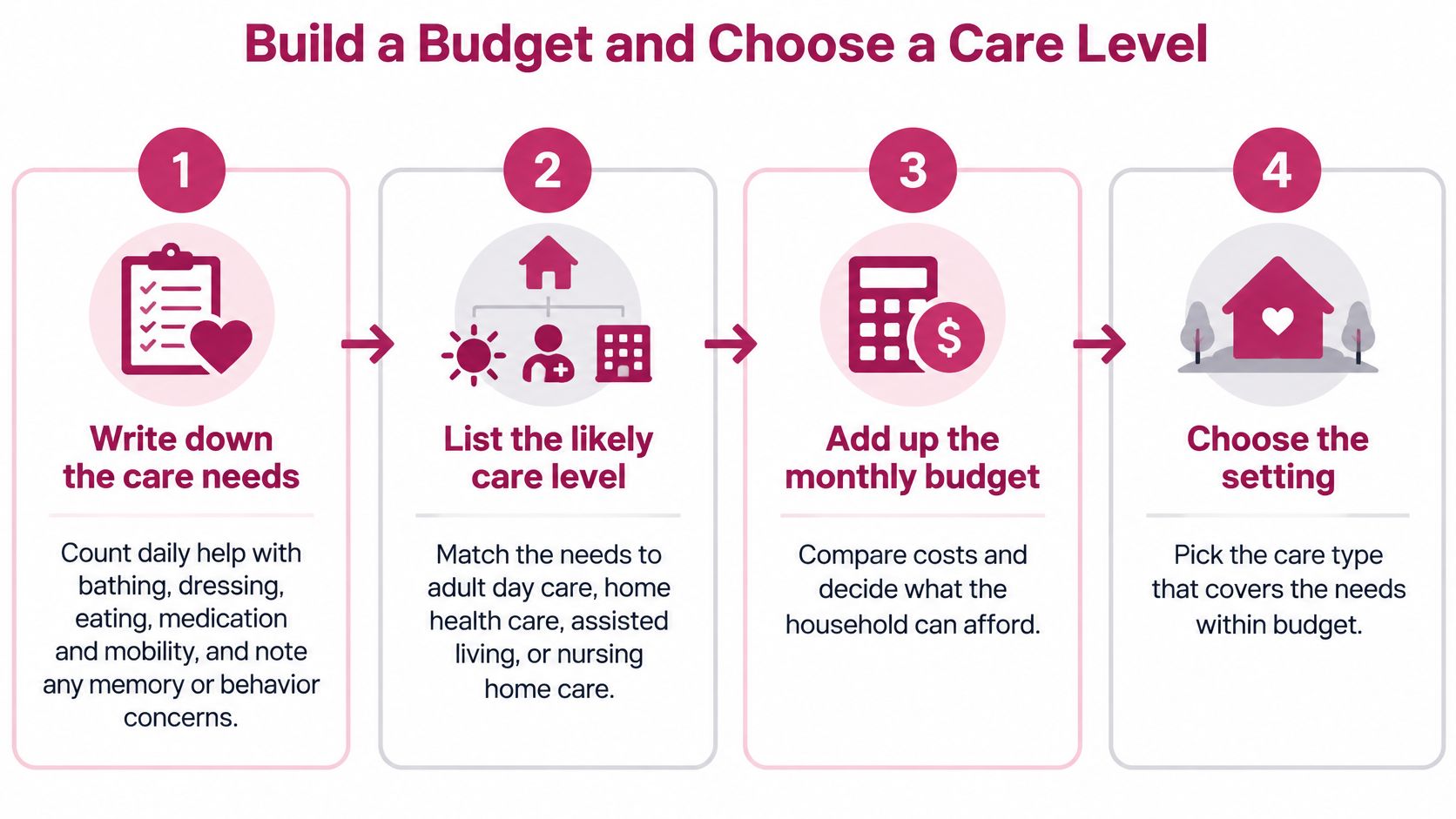
A useful elderly care budget connects needs, prices, and funding in one document. Start with a spreadsheet or a paper worksheet, whichever your family will update.
This visual summarizes the connection between assessing needs and choosing an affordable setting.
Follow a practical budgeting routine
- Write down the care needs because a service quote is only useful when it matches the person. Record assistance with bathing, dressing, eating, medication, toileting, and mobility. Note nighttime waking, confusion, wandering, and whether help must be immediately available.
- Estimate weekly hours and likely duration because occasional assistance and continuous supervision require different plans. Use a weekly calendar to identify gaps between paid visits and family availability. Include weekends and the periods when the primary caregiver needs rest.
- Choose the appropriate care setting because amenities can't substitute for necessary support. Have the person's needs assessed rather than choosing from photographs alone. If transfers, swallowing, medication, or cognitive safety are concerns, establish what the setting can manage before discussing apartment preferences.
- Obtain written, individualized prices because starting rates don't establish the final obligation. We help families compare local options against their needs and budget. Keep each assessment, included-service list, fee schedule, and agreement together so the comparison remains consistent.
- Build an annual total because monthly billing can hide irregular expenses. Multiply recurring monthly costs across the year, add expected one-time charges, and create a separate contingency line. Don't assume a fixed buffer will cover every possible increase; model both a rate change and a higher level of assistance.
- Assign funding to each expense because an unexplained gap is still an unpaid bill. Separate recurring income, planned savings withdrawals, insurance payments, and any confirmed benefit contribution. Mark pending benefits as pending rather than counting them as available cash.
- Verify the setting before signing because financial fit alone doesn't establish suitability. Check state licensing, tour while daily routines are underway, and ask how staff handle changing needs. Have the agreement reviewed, including discharge provisions, refund terms, and responsibilities when a resident needs more support.
Test whether the plan holds together
Ask these questions together, ideally with the older adult involved:
- Monthly fit: Does reliable income cover the recurring bill and the person's remaining expenses?
- Savings runway: Can accessible funds cover the shortfall for the expected care period without compromising a spouse's necessities?
- Changing needs: Which setting and funding source would support more intensive assistance?
A family's willingness to help belongs in this discussion, but so do boundaries. Record who can provide transportation, attend appointments, handle bills, and respond to urgent changes. Don't leave those responsibilities implied.
If moving is likely, include the practical work of sorting belongings, preparing the home, and coordinating the transition. DIYAuctions' resource on planning relocation for an older adult can help organize that separate part of the process.
The following video is an additional resource to consider while preparing for care discussions.
Finish with a budget you can revisit
Before a planning call, gather recent income statements, account balances, insurance information, benefit notices, and the weekly care schedule. Our guidance is free for families because participating communities pay a placement fee.
Your finished worksheet should show an annual total, a named funding source for every part, and a date to review the plan. Revisit it after a care assessment, a hospital stay, a pricing notice, or a change in family availability.
Life Senior Placement offers free, objective guidance to help your family compare New Jersey care settings and locally priced options against a realistic budget. Visit Life Senior Placement or call (862) 398-2006 with your care-needs list and financial outline to begin building a practical shortlist.