
You're at the kitchen table with a brochure stack, a discharge summary, and a parent who says they're “fine,” while you can see they're not. The mistake most families make at this moment is shopping for a building before they've audited the care that's really needed. Assisted living & memory care is not a style choice, it's a support-level decision, and the right answer comes from cognition, mobility, supervision, and behavior, not the marketing label on the front desk.
| Dimension | Assisted Living | Memory Care |
|---|---|---|
| Main purpose | Daily support in a residential setting | Dementia-focused support with added supervision |
| Best fit | People who need help with routine tasks but still function fairly independently | People who need structure, security, and dementia-specific routines |
| Environment | Apartment-style, social, less restrictive | More controlled, more cue-based, more secure |
| Staffing focus | Help with personal care, meals, meds, reminders | Dementia-aware supervision, wandering prevention, behavior support |
| Decision trigger | Difficulty managing day-to-day life safely | Wandering, disorientation, unsafe judgment, or increasing supervision needs |
Why the Real Question Is Care Level, Not Community
A daughter sits across from me and says, “Mom can still bathe herself most days, but she left the stove on twice and got turned around coming home from the mailbox. Do we need assisted living or memory care?” That's the right question. Not “Which place looks nicest?” but “What level of help keeps her safe without stripping away more independence than she needs?”
Start with the care problem, not the brochure
Age alone won't tell you the answer. The CDC's 2022 analysis found that 4.0% of adults aged 65 and older reported ever receiving a dementia diagnosis, and the rate rose from 1.7% for ages 65 to 74 to 13.1% for adults 85 and older, which is why age-related cognitive decline has to be part of the placement conversation (CDC National Health Interview Survey analysis). The point isn't to turn a diagnosis into a destiny, it's to avoid underestimating how quickly support needs can change.
Families often start by asking whether a community has “good memory support,” then discover that the core issue is whether the person needs medication oversight, cueing for bathing, help transferring, or supervision at night. Before touring, it helps to clear out the home environment too, because clutter can mask the true level of support needed. A practical starting point is how seniors can declutter their home, especially when the goal is to judge what's manageable versus what's becoming unsafe.
Practical rule: If the question is still “How much help is actually needed?” you're not ready to compare amenities yet.
The honest intake comes first. List cognition, mobility, behavior, medications, and overnight safety, then decide whether the person needs residential support, dementia-specific supervision, or help staying home longer. Once you do that, the search stops feeling like guesswork.
What Each Care Level Actually Provides
Think in four buckets, cognition, activities of daily living, behavioral risk, and supervision. That framework keeps families from confusing a pretty apartment with an appropriate care plan.
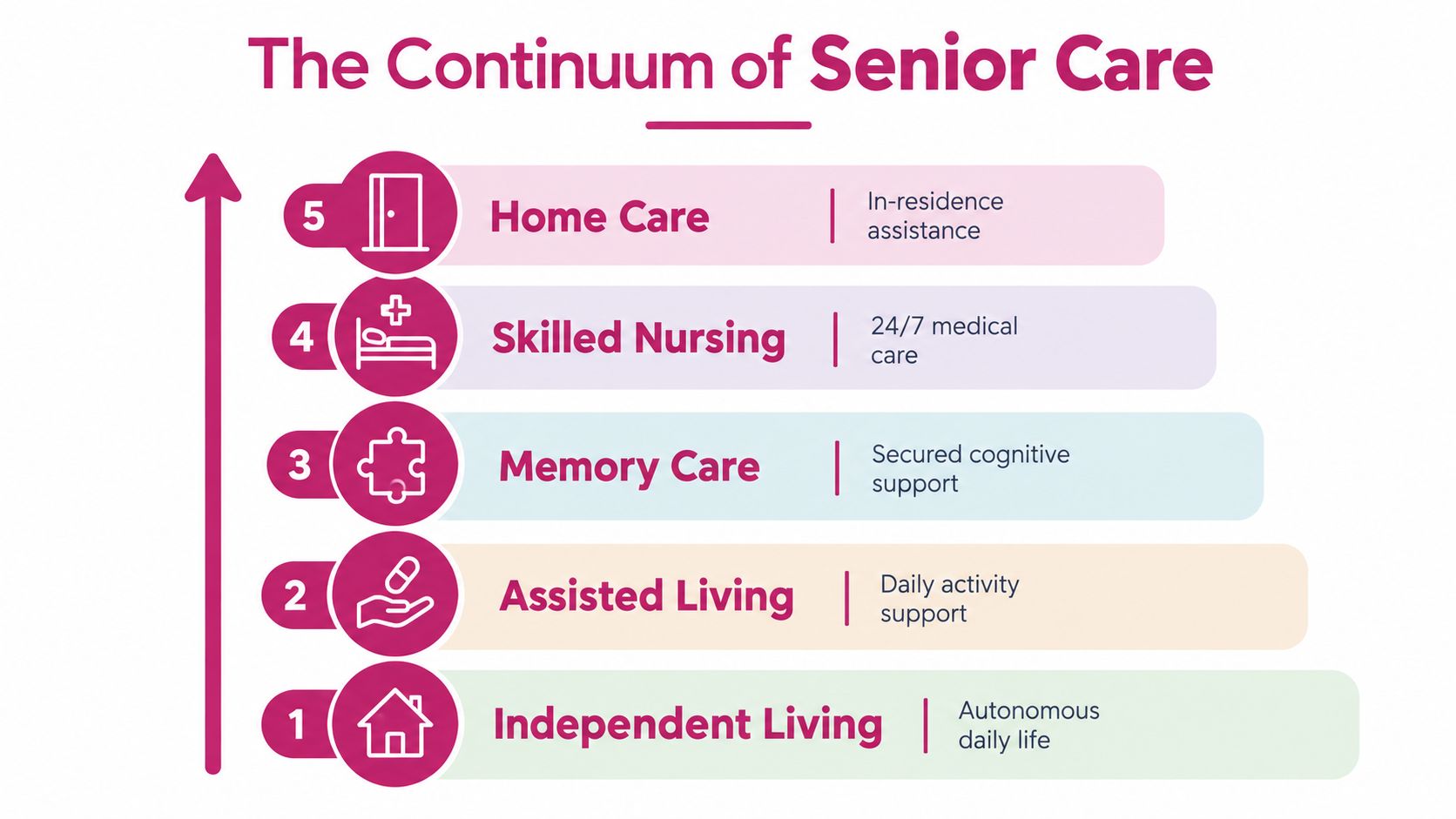
The continuum in plain language
Independent living is for someone who can manage daily life with little to no hands-on help. Home care brings assistance into the person's current residence, which can work when the person still recognizes the home, accepts help, and doesn't need secure supervision. Assisted living adds meals, personal care, medication reminders, and support with routine tasks while preserving a residential feel.
Memory care is not just assisted living with a locked door. It adds dementia-specific staffing, structured routines, environmental cues, and supervision for wandering, confusion, and changing behavior. The memory care overview on Life Senior Placement fits right into that distinction because the difference isn't cosmetic, it's operational.
Skilled nursing is the next step when the person needs 24/7 clinical oversight, rehabilitation, or more intensive medical management. That's a different lane entirely.
A useful way to ask the first intake question is simple:
- Can the person still understand and follow ordinary routines?
- Do they need help with bathing, dressing, meals, or medications?
- Are there behavioral symptoms, wandering, or nighttime confusion?
- How much supervision is required when no family member is present?
Why the setting matters
New Jersey families also need to pay attention to licensing. Assisted living residences, dementia care homes, and personal care homes don't all do the same thing, and a community's license tells you what it can legally provide. Don't let anyone blur that line with vague language.
If a community says it offers “support,” ask what that means at 2 a.m., not just during a sales tour. The right setting is the one that matches the person's actual care profile, not the one with the prettiest common room. For activity expectations in a residential setting, activities for assisted living is a useful lens because good programming still has to fit the person's abilities, not just fill the calendar.
Assisted Living vs Memory Care Side by Side
The cleanest way to separate these two is to look at what happens after the tour ends. Assisted living is built to support independence. Memory care is built to lower risk when cognition makes independence less reliable.
What changes in practice
Assisted living works well when someone needs help with daily routines but still does better in a flexible, social setting. Memory care is the stronger fit when the person needs closer supervision, repeated cueing, or protection from wandering and confusion. That difference shows up in staffing, floor plans, daily schedules, and how families get updates.
Families often fixate on “24/7 care,” and that phrase says almost nothing. Ask who is awake, who is trained in dementia care, who handles behavior changes, and how staffing shifts by time of day. CMS advises comparing direct-care hours per resident per day instead of leaning on a simple resident-to-staff ratio, because that gives you a better apples-to-apples comparison (CMS staffing guidance).
Learn how assisted living supports daily routines in our assisted living overview.
| Dimension | Assisted Living | Memory Care |
|---|---|---|
| Staffing focus | Help with daily tasks, reminders, and routine support | Dementia-aware supervision, cueing, and behavior response |
| Environment | Residential, social, lower security | More controlled, secure, and easier to move through |
| Programming | General social and recreational activities | Structured routines and dementia-appropriate engagement |
| Medication support | Often included, but with less intensive oversight | More frequent monitoring and tighter management |
| Family experience | More flexibility and a lighter touch | More communication around safety, behavior, and changes |
| Resident profile | Higher functioning, lower supervision needs | People with disorientation, wandering risk, or higher supervision needs |
Don't let marketing flatten the distinction
A community can look warm and polished and still be the wrong fit if your parent is unsafe without repeated supervision. A person with mild cognitive decline does not automatically need a secured setting just because the word “dementia” appears in a chart. The right answer comes from need, not fear.
Resident profile matters more than amenities. Assisted living can be a good fit when memory loss is mild and wandering is not the issue. Memory care is for the cases where safety, structure, and specialized oversight are no longer optional.
How Co-Located Communities Handle Both
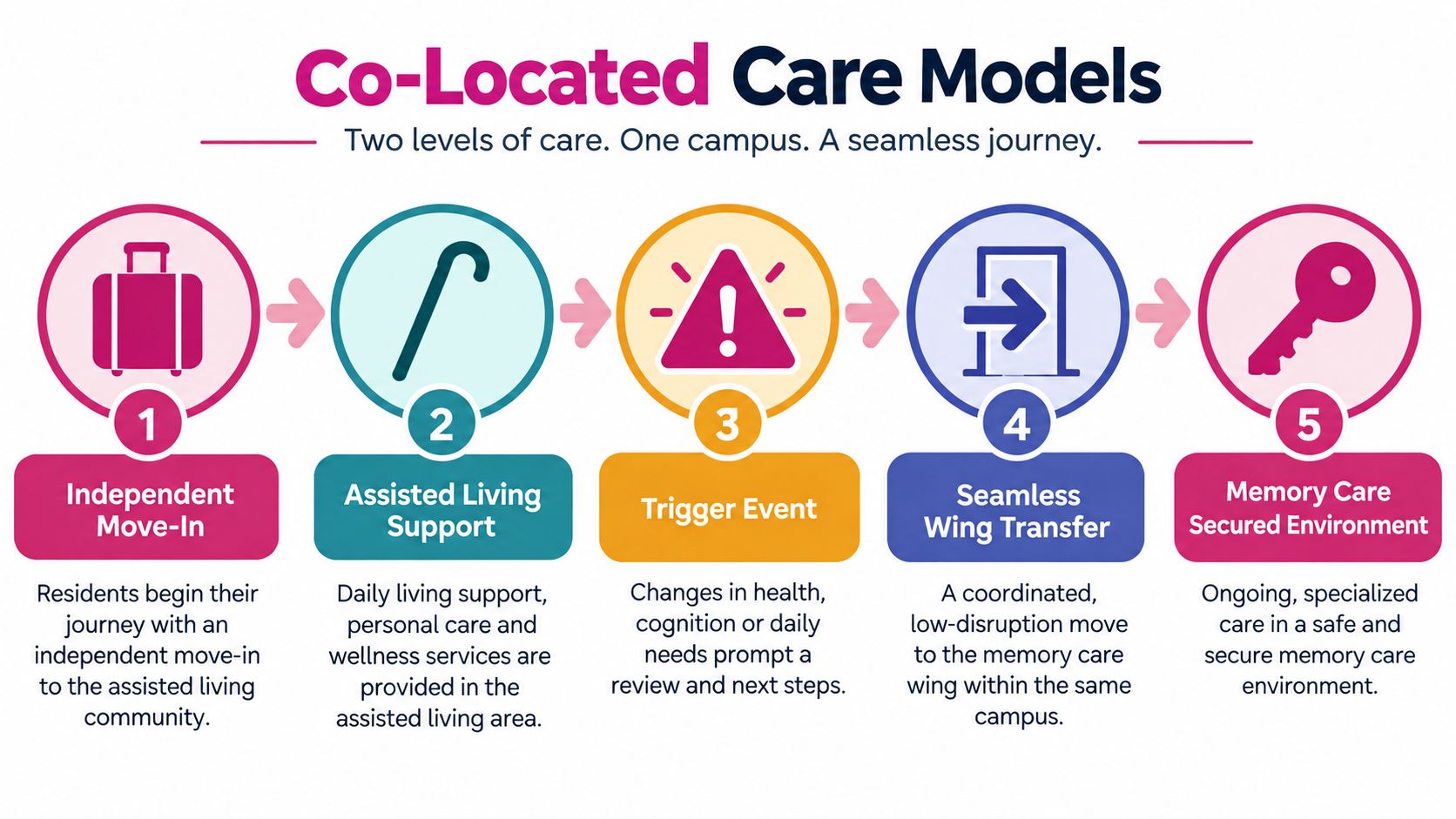
A lot of communities now market both assisted living and memory care on the same campus. That can be a real advantage, but only if the transition is genuine and not just a locked wing with a nicer label.
Continuity works when the handoff is real
When co-located communities are well run, a resident can move from assisted living into memory care without losing their whole social world. Staff already know the person's routines, the family already knows the building, and the move is less disruptive than starting over somewhere new. That continuity matters when cognitive decline makes change harder.
The trade-off is simple. A true memory care unit should have dementia-focused staffing, routines, and environmental safeguards. If a community only secures one section of an assisted living building without meaningful changes in programming or supervision, families should be skeptical. Ask whether staff are assigned separately, how transitions are triggered, and whether the dining, activity, and safety protocols differ by level of need.
A co-located campus is only useful if the higher-support side is actually built for dementia care, not just enclosed for convenience.
Shared dining and shared programming can be a plus when they're intentional. Separate staffing pools, transition protocols, and clear criteria for escalation are what make “aging in place” a real process instead of a marketing promise. Families should ask how the community handles medication changes, nighttime confusion, wandering, and a new need for hands-on personal care.
When Memory Care Is and Is Not the Right Answer
A dementia diagnosis by itself does not force someone into memory care. That's too blunt, and it leads to premature moves that can unsettle a person who still does better with lighter support.
The red flags that matter
Memory care starts to make sense when the person wanders, gets lost, or can't safely move through familiar spaces. It also becomes the right call when sundowning, agitation, medication errors, or unsafe judgment make the home environment unstable. Caregiver burnout matters too, because a strained household can't provide reliable supervision forever.
But some people are better served by a slower step. Assisted living can still work when the main issues are reminders, meal support, social structure, or light cueing. Enhanced home care can also buy time when family support is strong and the environment can be made safer.
Recent research shows the gap clearly. One 2025 study found that unmet needs in dementia care often include daily-living help, home modifications, resource access, socialization, individual preferences, and caregiver capacity, which is why the home environment has to be judged rather than emotionally. Another 2025 analysis reported that 98.6% of people with dementia had at least one unmet need and 63.5% had unmet needs across major domains, with loneliness linked to higher odds of unmet environmental needs (NeurologyLive summary of the study).
If safety problems are increasing and the family is improvising every day, the question is no longer “Can we keep doing this?” It's “What setting is actually sustainable?”
That's the line. Memory care is not a surrender. It's a decision to trade household improvisation for structure, supervision, and a setting built for dementia.

What to Verify on a Tour
A polished tour can hide weak care. Watch how staff move, how residents are queued up for meals, and whether people look supported or merely managed.
Use the building as evidence
Start with staffing. Review direct-care hours per resident per day, shift coverage, licensed-nurse availability, turnover, and agency use, because those details tell you far more than a brochure ever will (CMS staffing guidance). Ask how staffing changes when residents start falling, wandering, or need two people for transfers.
Then inspect the environment. Dementia-design research points to smaller-scale settings, lower noise, visual cues, unobtrusive safety features, and clear orientation aids as helpful, while exit-design experiments show that floor patterns can influence wandering in surprising ways (Bruyère systematic review summary). Look closely at lighting, glare, signage, contrast, hallway length, and whether bathrooms are easy to find without making the place feel confusing.
The psychosocial side matters just as much. Research on unmet needs in dementia points to psychological distress, weak daytime activity, and lack of companionship as common gaps, so a quiet building is not enough if residents are isolated or under-stimulated. Ask how the community handles one-to-one interaction, family updates, personalized activities, and residents who do not join group programs easily.
Practical rule: A secure setting can still produce poor outcomes if engagement and belonging are treated like extras instead of core care.
Use a strong question list before you walk in, and keep questions to ask at every assisted living handy as your baseline. Then add dementia-specific questions on top of it.
A good tour scorecard should cover these points:
- Staffing intensity: Ask who is on duty during the day, evening, and overnight.
- Security features: Verify how wandering risk is handled without turning the unit into a maze.
- Activity quality: Look for adapted programs, not just a calendar full of generic events.
- Dining flexibility: Ask how the kitchen handles appetite changes, preferences, and cueing.
- Family communication: Find out how often staff update families about mood, behavior, and participation.
If the tour sounds good but does not show how the community handles decline, keep looking.
Three Scenarios That Change the Recommendation
An 80-year-old with mild cognitive impairment and reliable family support usually doesn't need the same setting as someone who wanders at night. That sounds obvious, but families still compare people by diagnosis instead of by function.
Scenario one mild decline and strong support
If the person can still recognize routines, accept reminders, and stay safe with help at home, start by testing whether home care or assisted living fits better. The key is supervision during gaps, not the label on the diagnosis. If the family can cover those gaps and the environment is stable, memory care may be premature.
Scenario two mid-stage Alzheimer's with wandering
Once wandering enters the picture, the recommendation changes fast. Assisted living can still work for some people with early cognitive loss, but wandering turns this into a safety issue, not just a support issue. A secured memory care setting is usually the cleaner answer when the person gets lost, exits impulsively, or can't reliably follow directions.
Scenario three one spouse is carrying the load
When one spouse has advancing dementia and the other is the primary caregiver, household capacity becomes the deciding factor. If the well spouse is exhausted, the home can stop being safe long before the diagnosis reaches its most advanced stage. Co-located communities can be a strong option here because they can preserve the relationship while giving the higher-need spouse more structure.
The Alzheimer's Association estimated that 6.9 million Americans aged 65 and older were living with Alzheimer's dementia in 2024, about 1 in 9 in that age group, with prevalence reaching 33.4% among those 85 and older (Alzheimer's Association facts and figures). Those are the kinds of cases where the care plan has to keep up with progression.
Putting the Decision Into Action
Before the first advisor call, write down the facts that matter: diagnosis, recent incidents, current medications, mobility limits, sleep problems, nighttime supervision needs, and who is providing care now. If you show up with feelings only, you'll get a vague answer. If you show up with specifics, you'll get a usable shortlist.
Ask any placement service how it screens for licensure, how it matches communities, and whether it coordinates tours or just hands out names. You want a process that starts with intake, then narrows to licensed options, then compares what each community can do for your parent's current and likely future needs. The platform you choose should make that sequence visible, not hidden.
On tours, bring the medication list, a copy of the latest care notes, a notebook, and a hard question about what happens if needs change in six months. Then ask for the exact move-in and reassessment process, because the best decision today still needs a path for tomorrow.
Life Senior Placement works as one New Jersey-based option for families who want help matching assisted living, memory care, home care, or nursing home choices to the actual care need. It's most useful when you want a structured intake, curated community matches, and support through touring and move-in, without pretending every family needs the same answer.
If you're trying to sort through assisted living & memory care in New Jersey, use Life Senior Placement to start with the care audit instead of the sales pitch. Bring your parent's real needs, not just a diagnosis, and let the placement conversation begin there.