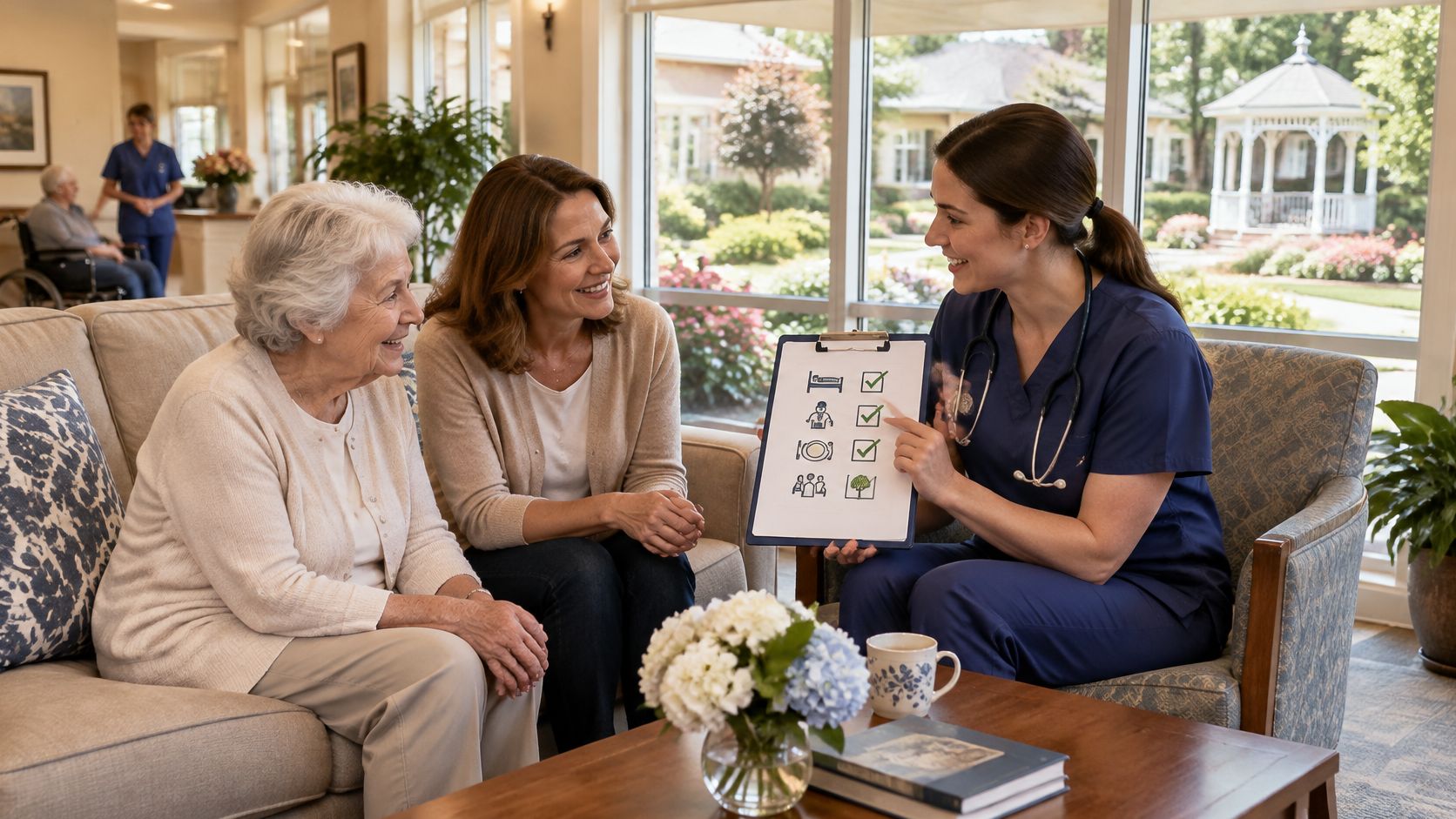
Three things tend to land in the same month. A follow-up appointment gets scheduled, a pharmacy bag arrives with a new prescription, and someone in the family notices the laundry has stopped getting done. Nobody calls that a crisis. It becomes the new normal one errand at a time.
Then you start pricing out assisted living for married couples and hit a wall. Nearly every guide answers the same two questions, whether two people can share an apartment and what the second-person fee runs, then stops. The harder question goes unanswered: what happens when one spouse needs a level of care the other doesn't, and what happens if that gap widens six months after move-in.
Treat the couple as two separate care plans sharing one household, and the decisions get clearer. So does the hidden cost of getting it wrong, which is not a fee at all. It's a forced separation after the boxes are unpacked.
Living Arrangements Couples Can Choose From
Consider a couple in their late seventies. One still drives, pays the bills and hosts Sunday lunch. The other has started needing a steady arm in the shower and someone to lay out the morning pills. Neither is in crisis. They're running two different lives under one roof, and the gap between those lives widens a little each year.
Most consumer explanations of assisted living for married couples answer two questions and stop: can we share an apartment, and what's the second-person fee? The choice has more shapes than that. Few guides explain how a couple stays inside one community when their care levels split, how a transfer works when one spouse's needs rise, or whether two people living in different care settings can still eat dinner together every night.
Couples rarely move for convenience. In an exploratory study of 20 married couples in assisted living facilities, relocation commonly followed a major health transition affecting one or both spouses, and the need for care was often asynchronous, meaning one spouse needed substantial support well before the other (analysis of married couples in assisted living). That single finding reshapes the decision: you aren't picking one arrangement, you're picking one that can hold two care plans.
Living arrangements for couples with different care needs
| Arrangement | Who shares a unit | Care levels that fit | Main trade-off |
|---|---|---|---|
| Same unit | Both spouses | Both at similar needs | Companionship is preserved, but one spouse's decline can make the shared space unsafe or impractical |
| Same campus, different care neighborhoods | Spouses in separate units | One in assisted living, the other in memory care or nursing care | Daily contact stays possible without forcing one spouse into the other's care tier |
| Separate communities nearby | Spouses in different buildings | Different needs with different operators | Visits and transport must be planned, and emergency contacts are split |
| Independent living for one, assisted living for the other | Separate units on one campus or nearby | An active spouse alongside a spouse who needs daily help | Billing differs by unit, and the healthier spouse may drift into an unpaid caregiving role |
Read the table from the inside out. Start with what each spouse needs this month, not with the fact that they're married, because the marriage is the constant and the care needs are the variable. Then ask which of the four rows can absorb a rise in either spouse's needs without a second move.
The best answer for most couples is the arrangement with the shortest distance between care levels, a campus where independent living, assisted living and memory care sit within the same building or a short walk apart. A close second is two communities within a short drive. What deserves the hardest look is the fully shared unit with no plan for what happens when one resident's needs outgrow it.
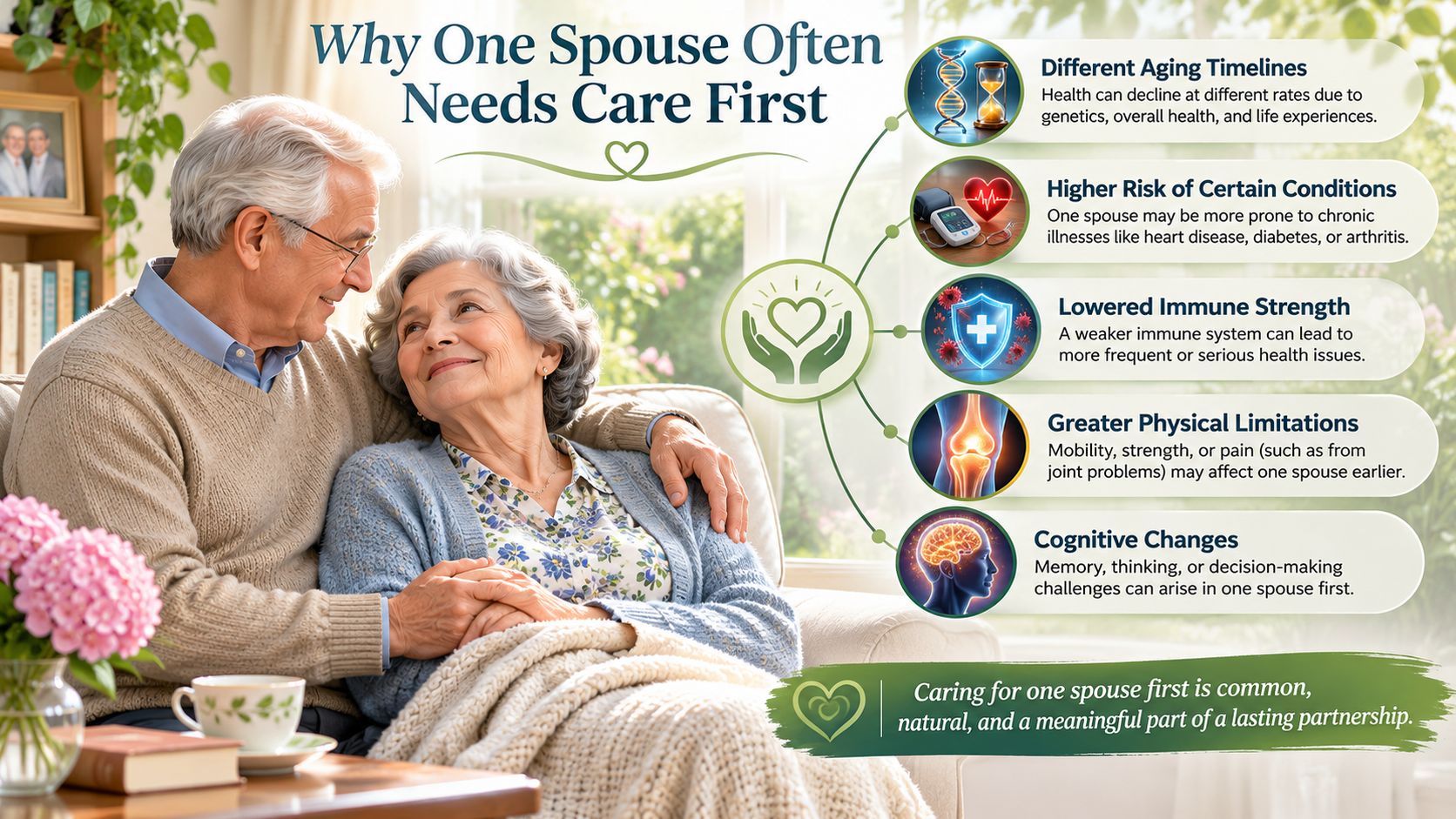
Why One Spouse Often Needs Care First
A tandem bicycle works like a marriage in later years. Two riders share one frame, one direction and one set of handlebars, but the effort is rarely even. One pedals hard up the hill while the other rests, then they swap. Aging runs the same way. Age differences, genetics, an old injury, a diagnosis nobody saw coming, and the pair who finished each other's sentences at sixty can be living very different health histories at eighty.
Marriage changes the odds of placement. A U.S. Analysis found that married older adults were approximately half as likely as unmarried adults to enter a long-term-care facility, largely because a spouse is at home to cook, drive, remind and watch (U.S. Analysis of long-term-care entry and marital status). A spouse acts like an unpaid care coordinator who notices the small changes early.
Family structure matters too. Lacking a spouse or adult children can raise the risk of long-term-care placement, especially when there is no one nearby to notice changes, provide rides or step in during a crisis. That is why a couple should be viewed as two separate care plans sharing one household. The healthy spouse may be holding together two routines at once, and the arrangement can look stable right up to the day one person needs more help than the other can safely provide.
Where the protection stops
Marriage delays placement. It does not cancel it. The protection wears down when caregiving demands exceed what the couple can safely manage at home, and that threshold has nothing to do with how devoted they are to each other.
Say a husband walks with a cane, needs a reminder for his heart medication, and can no longer lift the storm windows. His wife has early memory changes that make her unsafe at night: she wakes, does not recognize the hallway, and has twice left the front door open. Neither needs a nursing home. Together they need two different plans, one built around mobility and medication, one built around overnight safety.
That is the hidden cost couples often miss. A shared household can work well while both needs stay modest. When one spouse's care level rises after move-in, a forced separation can carry a price the original choice never showed on a monthly fee sheet. Daily help with dressing, medication and meals may be available in assisted living, but another spouse's memory or safety needs may point to a different setting.
Three signs the caregiving load has tipped
- Broken sleep for weeks. Not one bad night, but a stretch that leaves the well spouse foggy at the wheel and short-tempered with the person they are caring for.
- A fall the spouse cannot safely help with. If getting a partner up off the bathroom floor now requires a neighbor or a 911 call, the home setup has already stopped working.
- Missed or doubled medication doses. The pillbox has become a memory test, and nobody is winning it.
These signals call for a placement conversation, not panic. They mean the arrangement needs professional eyes while there is still time to choose. Waiting can narrow the options to whatever has a bed available this week, and it can push one spouse into a care tier that would have been avoided with an earlier, calmer comparison.
What to Document for Each Spouse
Assess each spouse separately, in separate conversations, with the same family member present for both. If one partner is the confident talker, they'll answer for the pair, and the quieter one's night-time confusion or fear of the stairs never makes it onto the form. Bring physician notes, the current medication list, and the dates of recent falls and hospital visits. Those three documents do more work than an hour of recollection.
The person taking notes should keep each spouse to a single page. Communities read fast, and two pages side by side let a care director see the gap between the spouses in about ninety seconds. Here is what belongs on each page.
Per-spouse assessment areas for a couple
| Assessment area | What to record | Why it matters for a couple |
|---|---|---|
| Activities of daily living | Bathing, dressing, toileting, transfers and eating, with how often hands-on help is needed | Sets the care tier and drives the second-person fee where two transfers are required |
| Cognition | Memory, orientation, safety judgment and any wandering | Decides whether memory care is needed and whether the spouse can stay in a shared unit |
| Mobility | Walking distance, equipment used, and falls in the last six months | Affects unit placement, transfer needs and night-time response |
| Medications | Number of medications, schedule, and who administers them | Medication management is a tiered care item that can change the monthly bill |
| Privacy and social preferences | Preferred privacy, group activity, and how much time the spouses want together | Shows whether shared dining or separate schedules will fit |
| Caregiving capacity | Hours the healthier spouse can provide, sleep, and personal health | Shows whether co-caregiving is sustainable or will break down within months |
Reading the two records together
The first three areas set the care tier. The last three decide whether the couple can live with the arrangement day to day, and they're the ones families skip because they feel less clinical. They aren't. A husband who wants the door closed and a wife who wants a bridge game in the lounge every afternoon are describing two different daily lives, and a good community can accommodate both.
When one record lands a tier above the other, that gap becomes the test the whole arrangement has to pass before anyone packs a box.
Practical rule: if the two records would produce two different care tiers, don't shop for a shared apartment first. Shop for a building that can hold both tiers.
What Couples Pay and What Drives the Bill
Two communities can hand you the same-looking quote and mean very different things by it. Neither one is quoting a single flat rate for a couple. Each is quoting a base rate for the unit, then adding care charges that follow each resident's individual assessment, and that structure is what catches couples: two people in one apartment can produce two very different bills.
What makes up a couple's monthly assisted living bill
| Cost component | How it is billed | What changes the amount |
|---|---|---|
| Base monthly rate | Per unit, covering housing, dining and activities | Unit size, location and whether the unit is shared |
| Tiered care fee | Added per resident, based on help with bathing, medication and mobility | Each spouse's care assessment score, and any increase after move-in |
| Second-person fee | Added when a spouse needs two-person transfers or separate hands-on care | Whether the spouses share one care plan or carry two |
| Memory care rate | Usually higher than standard assisted living for a secure unit | Dementia programming and staffing levels |
| Independent living rate | Lower base rate with few or no care fees | Amenities, and whether care can be added later |
| Home care | Hourly or live-in rate for one spouse at home | Weekly hours of help and overnight coverage |
Life Senior Placement's listings put numbers on those rows. Base assisted living around Wall generally runs $5,500 to $9,200 a month, with the higher rates landing on residents who need extensive physical help or memory care services. In Elmer, the typical range is $4,800 to $7,500, rising when advanced personal care or two-person transfers enter the picture. For comparison, independent living around Lodi lists at $3,200 to $5,200 a month, which is why a spouse who needs no hands-on care looks very different on paper from one who does.
Life Senior Placement lists the New Jersey median for assisted living at $8,710 a month, the fifth highest in the country, against a national median of $6,200. A median, though, hides the thing that matters most to a couple. When one spouse's care tier rises after move-in, that spouse's bill resets upward while the other's stays flat. The steeper version is a forced split: if one spouse's needs outgrow the shared unit entirely, the household moves from one apartment to two rooms in two different levels of care, each carrying its own base rate. Two residents, two bills, one household budget absorbing both.
Ask for this in writing: a twelve-month projection that includes the tier changes you consider likely, not just today's rate.
That projection is what turns a comparison into a decision. A community quoting a modest base rate with an aggressive tier ladder can cost more within a year than one quoting higher from the start. The guide to assisted living costs walks through how those ladders get built.
Most assisted living is paid privately. Long-term care insurance may reimburse care once a spouse needs help with daily activities, and some states run Medicaid waiver programs that cover assisted living. Where Medicaid is involved, spousal protections can let the spouse still living at home keep a share of income and assets, but the rules differ by state and only the state agency handling the application can confirm the numbers for your household.
The video walkthrough below shows how these components stack up in practice.
An itemized contract beats a headline rate every time. If a community won't show you the base rate, the care tiers, the second-person fee and the written policy for tier increases in one document, you don't yet know what you're buying.
Togetherness Versus Shared Caregiving
Staying together is the goal most families arrive with. It's worth questioning, not because it's wrong, but because togetherness and shared caregiving are two different things, and only one of them is free.
Research involving 29 couples, 26 married and three unmarried, across eight assisted living facilities found real benefits: companionship, support and affection. The same couples described caregiver strain, reduced personal choice, and one spouse coming to be defined by the other's disability (study of couples living together in assisted living). Both lists are true at once. That's the part the brochures leave out.
Picture a wife who answers every night-time call from her husband because she's twenty feet away and it feels faster than waiting for staff. Within a month she's up three times a night, skipping the morning exercise class, and turning down the van trip because he might need her. She came to the community as a resident. She's now working a shift nobody pays her for.
The distinction that matters: sharing an apartment is not the same commitment as performing hands-on care.
What to put in the plan instead
Ask the facility to state, in writing, which tasks staff perform: bathing, transfers, toileting, medication management and night-time response. Then ask for separate service plans, so each spouse has a document describing their own care rather than a joint plan built around the needier one. Add private activity options, respite availability, and a written escalation pathway that names what happens when dementia, falls, incontinence or caregiver exhaustion increase.
Communication is the other variable. Spouses can compensate for each other's decline and draw each other into social contact, but that works best when they communicate well and each keeps independent relationships with other residents. A couple joined at the hip can become a closed unit, and the caregiving spouse ends up with fewer friendships in the building than the spouse receiving care.
Some families compare keeping the healthier spouse at home with paid help against moving both into a community. The comparison of home care and assisted living for a spouse covers that split directly.
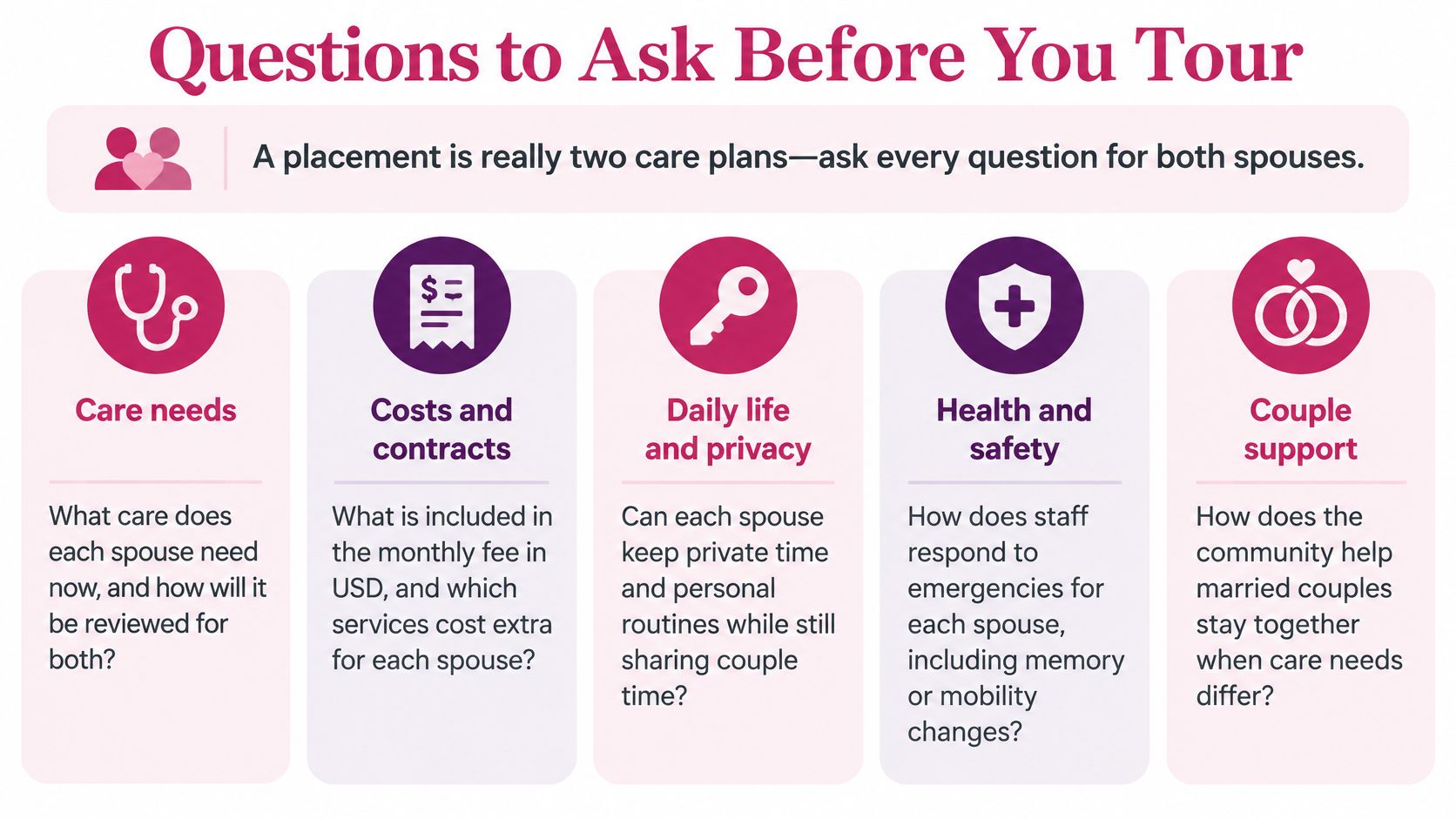
The questions below are worth carrying into every tour.
One test settles most of it. Would this arrangement still work if the healthier spouse got sick for three weeks? If the answer is no, the community is depending on that spouse's labor, and you've found that out before signing rather than after.
Questions to Ask Before You Tour
A placement is really two care plans, so every question below needs two answers, one for each spouse. Ask them out loud on the tour and write the answers down. Memory is generous to sales conversations.
Care changes
- What triggers a level-of-care review, and how often does it happen? A fixed annual reassessment is safer than a review that only happens after an incident.
- Can a spouse's care level rise without changing units? If a walker becomes a wheelchair, you want to know whether that means new equipment in the same apartment or a move down the hall.
Billing
- How is the bill split when the two needs differ? Ask for a sample invoice showing one spouse at a low tier and one at a high tier.
- What exactly does the second-person fee cover? Two-person transfers are different from two separate care plans, and communities define the fee differently.
Housing
- Are shared units, adjoining units or same-campus alternatives available, and how fast can a unit change? A one-bedroom shared by two people with different sleep schedules can turn into a daily argument.
Daily life
- Can spouses dine, visit and attend activities together when they're in different care neighborhoods? Ask whether the dining room in memory care is open to a spouse who lives in assisted living.
- Can each spouse keep private time and personal routines? One partner may want the door shut and a book; the other may want the lounge and a card game.
Safety
- How is night-time emergency response handled for each spouse? Ask how many staff are awake and on duty overnight, not how many are in the building.
- What happens when one spouse wanders or falls at 2 a.m.? The answer should describe a sequence, not a promise.
Transitions
- What written policy applies if one spouse moves to memory care while the other stays? This is the question that determines whether the couple's daily contact survives a change in condition.
"If it isn't in the contract, it isn't a policy."
Verbal assurances are hard to enforce and easy to forget during staff turnover. Ask for the transition policy, the tier schedule and the second-person fee definition as attachments to the residency agreement. If a community hesitates to put any of it in writing, that hesitation is itself information.
Our checklist of questions to ask an assisted living community covers the single-resident version, which is worth pairing with the couple-specific list above.
Confirm the Arrangement Before You Move
The decision works better as a sequence than as a single leap. Five steps, in this order.
- Complete a separate assessment for each spouse, covering daily activities, cognition, mobility, medications, privacy preferences and caregiving capacity. Two one-page records, not one shared narrative.
- Shortlist arrangements that match both assessments, not just the more demanding one. A plan built only around the spouse with dementia will leave the active spouse with nothing to do and nobody to eat lunch with.
- Request an itemized contract showing the base rate, every care tier, the second-person fee, and the written policy for tier changes. Compare contracts side by side, not brochures.
- Tour with the questions in hand and confirm the transition policy in writing before you sign anything.
- Set a review date three to six months after move-in to check whether each spouse's care level still matches the plan.
Free help exists at every one of those steps. Life Senior Placement offers a care quiz that helps families narrow down what level of help makes sense for each person, and advisors review verified communities and arrange tours at no cost. Families can call (862) 398-2006 to start that conversation.
The right arrangement is the one that still works when one spouse's needs change, because one of them will. Don't sign until the transition policy is on paper.
Life Senior Placement works with New Jersey families comparing assisted living, memory care, independent living and home care, including couples whose needs don't match. An advisor can review verified communities, walk you through what a shared unit and a split-level arrangement cost, and set up tours where you can ask the transition questions in person rather than over the phone. Start at Life Senior Placement to build both care plans together.