
Your mother is still in rehab, the discharge planner wants an answer by tomorrow, and the house at home has stairs she can't manage, pills she can't track, and a spouse who's already worn out. That's the moment most families land in assisted care for seniors, not because they want a “lifestyle change,” but because a real event has forced a real decision. The wrong move here is rushing to the nearest open bed and hoping the rest works itself out.
Families in that spot need clarity fast. The market is large, expensive, and crowded, with about 41,465 assisted living communities, nearly 1.4 million licensed beds, and more than 1,000,000 residents in the U.S., plus a national median rate of $6,200 per month or about $74,000 annually (Caring.com assisted living statistics). That's why a careful intake matters. Write down the diagnoses, mobility limits, cognition, medications, and the care your parent will and won't accept, then use that to filter options instead of guessing.
Signs your loved one is ready for senior living is a useful gut-check when you're deciding whether this is a temporary crisis or a permanent shift. The roadmap is simple, even if the situation isn't. First, understand what assisted care really does. Then compare settings carefully, match the setting to the highest current need, and use structured help when the timeline is tight.
When a Family Faces the Senior Care Decision
The call usually comes after a hospitalization or rehab stay. A discharge planner says your mother can't go home alone, your father's medications are a mess, and the old plan no longer works. Everyone in the family suddenly has an opinion, but nobody has time.
What actually triggers the scramble
This rarely starts with a casual preference. It starts with a fall, a stroke, a dementia diagnosis, or the collapse of the caregiver who has been carrying everything for too long. The pressure comes from three directions at once, safety risk, functional loss, and family exhaustion.
The mistake I see most often is moving too fast because a bed is available. That can lock a family into a setting that looks fine on day one and fails by month two. A better intake is blunt and practical, what diagnoses exist, how far the person walks, how the mind is changing, and what kind of help is nonnegotiable.
Practical rule: choose from the condition in front of you, not the hope that things will stay stable.
A rushed decision is expensive in every sense. You pay more in money, more in stress, and often more in regret. Families who slow down long enough to define the problem usually end up with a better fit, even under pressure.
The strongest decisions begin with a short list, not a random search. That list should reflect the boundary between assisted living, memory care, and nursing home care, not just a facility brochure. When the need is clear, the search gets shorter and the family gets calmer.
What Assisted Care Looks Like Day to Day
A good assisted community does not feel like an institution. It feels like a structured day of support that keeps a resident safe, fed, clean, and engaged without stripping away dignity. The work starts early and keeps going all day.
The morning layer
At 7 a.m., hands-on support usually begins with cueing, bathing, dressing, and help with incontinence care when needed. That help sounds basic, but it is the difference between a resident staying presentable and a resident losing ground. Strong communities handle it with routine, privacy, and consistency.
Medication management has to be tight. Staff should know which medications are given on site, how the medication record is tracked, and who checks timing and dose. Families should also read a plain-language guide like A Better Solution in Home Care resources before they compare community care with home support, because weak medication workflows create real risk.
Meals matter more than most tours suggest. Some places run restaurant-style dining with flexible seating, others use a fixed schedule, and the better ones can handle diet restrictions without making residents feel like a problem. Feeding assistance is part of the service, not an exception.
The middle of the day
After breakfast, the day should include housekeeping, laundry, and transportation to appointments when the community offers them. That layer is easy to overlook, but it keeps families from turning ordinary tasks into a constant logistics problem. Social programming should also be real, fitness, conversation, memory-friendly activities, and small group events that support mobility and cognition.
If you want a clear checklist for what assisted living includes, use it before you tour. Then watch how the day feels for the people already living there. Staff who greet residents by name and keep the schedule moving usually tell you more than a glossy brochure ever will.
The quiet failures matter most. Showers get missed, medications come late, and evenings are thinly staffed. That is where quality lives or dies.
Comparing In-Home Care and Residential Settings
Families often compare options as if they were all substitutes. They're not. Each one solves a different problem, and each one fails at a different point. You need to match the setting to the highest current need, not the easiest preference.
The four-way reality check
In-home care preserves familiarity and keeps the person at home, but it starts to break when coverage has to become constant. Assisted living works when the person needs help with daily tasks and med support, yet still wants a social environment and a manageable routine. Memory care is the right answer when dementia changes the safety profile, especially with wandering or confusion at night. Nursing home care belongs in the conversation when skilled nursing is required, not as a reflex.
A lot of families delay the move because the home feels emotionally easier. That's understandable, but it can become the wrong choice once supervision needs rise. If a senior is falling, sundowning, or missing medications, the home can turn into a patchwork of partial solutions.
If air quality and sleep are part of your concern in residential care, improve sleep in assisted living is a practical read for understanding how the environment affects rest. That matters because sleep loss makes cognition, mood, and mobility worse.
| Setting | Best For | Medical Acuity | Memory Support | Supervision | Social Environment | Typical Cost Range | Main Limitation |
|---|---|---|---|---|---|---|---|
| In-Home Care | Seniors who want to stay home and need scheduled help | Low to moderate | Limited unless added separately | As arranged by family and aides | Familiar but often isolated | Varies by hours and agency | Breaks down when 24-hour coverage is needed |
| Assisted Living | Daily support with meals, meds, and personal care | Moderate | Limited unless special programming exists | Built-in, but not clinical around the clock | Active and communal | Private-pay oriented | Capped when care needs become complex |
| Memory Care | Dementia-related supervision and structure | Moderate, with cognitive focus | Strong, secured | Higher and more specialized | Structured and controlled | Usually higher than standard assisted living | Not designed for advanced skilled nursing needs |
| Nursing Home | Daily skilled nursing and complex clinical care | High | Present, but secondary to clinical care | Highest | More medical than social | Highest care intensity | Not the right answer for routine daily help alone |
The rule is simple. If the highest need is daily support, assisted living can work. If the highest need is memory-related safety, choose memory care. If the highest need is skilled medical oversight, stop trying to stretch assisted living past its boundary.
Services Most Communities Provide and Where Quality Varies
Most assisted communities sell the same basic package. The key difference is whether those services hold up on an average Tuesday, a weekend night, or during a staffing crunch. Families should press on that point, because the tour-day version is usually the polished version.
The service stack
Expect help with personal care, medication management, meals, housekeeping, laundry, transportation, social programming, and some level of 24-hour staffing. The list sounds uniform. The delivery is not. Medication management deserves the closest look, because a missed dose or poor tracking can create immediate problems.
Night staffing separates a solid community from a shaky one. A building can look orderly in the afternoon and still fail residents when someone falls, wanders, or wakes confused at night. Ask how the community handles evenings, overnights, and call response, not just daytime coverage.
The brochure tells you what the community wants to sell. Staff behavior tells you what it can actually deliver.
Meals and activities need a longer look than the sales tour gives you. A dining room can seem lively once and still serve repetitive food with weak follow-through. An activity calendar can look full while residents sit on the edge of the room and do not participate. Ask for recent menus, ask how often residents join programs, and ask about staff turnover. Marketing language does not answer those questions.
Some services are often assumed and then billed or limited later. Incontinence supplies may have caps. Two-person transfers can cost extra or be refused. Hospice coordination may be partial. Couples with very different care needs may not fit well in one apartment. These are not small details. They decide whether a place works after move-in.
| Service | What to Expect | Where Quality Varies Most | Key Question to Ask |
|---|---|---|---|
| Personal care | Help with bathing, dressing, and toileting | Consistency and privacy | Who provides hands-on help during evenings and weekends? |
| Medication management | Administered or supervised meds | Timing, documentation, and follow-up | How do you track late doses and medication changes? |
| Meals | Three meals and snacks in some form | Quality, flexibility, and diet handling | Can you show a recent menu and describe special diets? |
| Housekeeping and laundry | Routine room and linen support | Frequency and responsiveness | What gets done weekly, and what costs extra? |
| Transportation | Medical rides and local outings | Scheduling and availability | How far ahead do I need to book a ride? |
| Social programming | Fitness, games, outings, and group events | Attendance and resident engagement | How many residents actually participate? |
The right question is not whether a community offers these services. It is whether the staff can deliver them consistently when residents need help most.
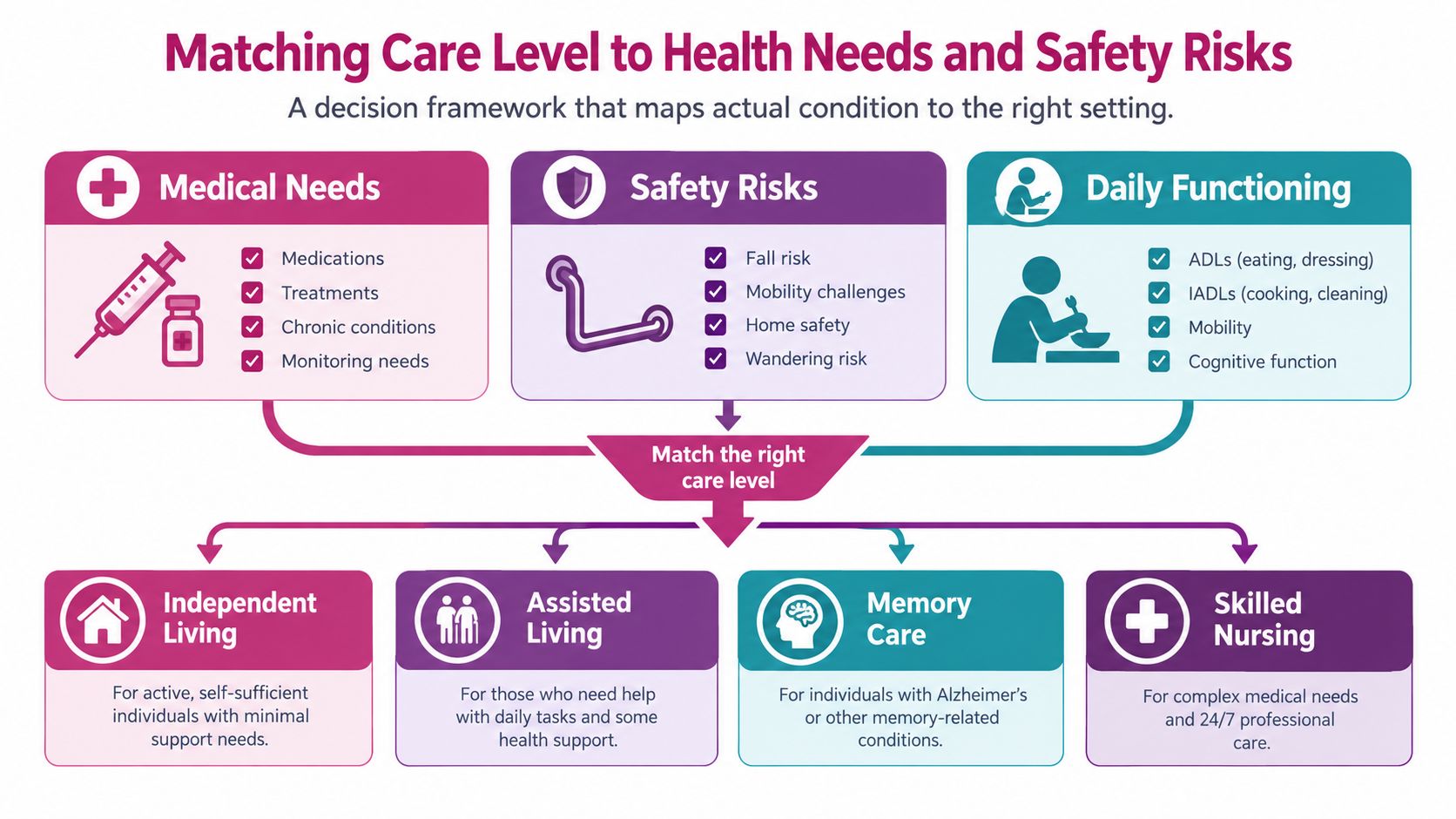
Matching Care Level to Health Needs and Safety Risks
A bad match shows up fast. The resident may be medically “fine” on paper, yet still be unsafe because they fall, wander, refuse help, or cannot manage nighttime confusion. That is the boundary families miss.
Start by focusing on the risk, not the label. Assisted living works for stable health with regular personal care and supervision. Memory care is the right call when dementia creates exit-seeking, sundowning, or behavior that puts the person at risk. Nursing home care belongs where skilled needs, such as wound care, IV therapy, or complex post-surgical recovery, require licensed medical oversight.
Mobility often decides the issue before diagnosis does. A person who keeps forgetting the walker, is unsafe in the bathroom, or cannot move around without help needs a setting that can respond immediately. Driving, cooking, and medication self-management count here too. They are safety issues, not lifestyle preferences.
A good tour tests capacity, not brochure language. Ask the director what happens if the resident starts wandering, needs two-person transfers, develops swallowing trouble, or begins refusing care. Ask where the line is between “we can handle that” and “we would ask the family to move them.” That answer tells you whether the community can absorb escalation or only manage the current snapshot.
Look for warning signs on site. A rushed tour, vague answers about staffing, no clear explanation of behavior policies, or a shrug about future decline all point to trouble later. The same goes for communities that say yes to everything but cannot explain how they handle a resident who becomes more confused, more dependent, or medically unstable.
Write down the current medications, the last fall, nighttime confusion, wandering, appetite, and whether the person accepts help. Then keep only the settings that can cover the riskiest item on that list without stretching their limits.
How a Placement Advisor Changes the Search
A family in New Jersey usually calls after the first round of tours fails. The building looks fine, the brochure sounds reassuring, and then the hard questions start. Who handles wandering? What happens after a fall? Can this place take someone whose needs are already moving past simple assisted living? A placement advisor cuts through that fog fast and points families toward the right level of care before they waste time in the wrong ones.
A seasoned advisor starts with the facts. Medical history, medications, mobility, cognition, behavior triggers, budget, geography, pets, diet, and the family's red lines all go into the intake. That gets narrowed into a shortlist that fits, not a long stack of communities that only sound good on paper. If you want to see how the process works, senior placement services exist for exactly this kind of filtering.
[{"text":"The true value is in the questions families do not know to ask. Staffing by shift, antipsychotic policies, discharge triggers, and what happens when care needs escalate tell you whether a community can handle assisted living, memory care, or a nursing home level problem without forcing another move too soon. When two settings seem possible, choose the one that handles the higher-risk need immediately. Upgrading later is harder than starting right.","type":"text"}]
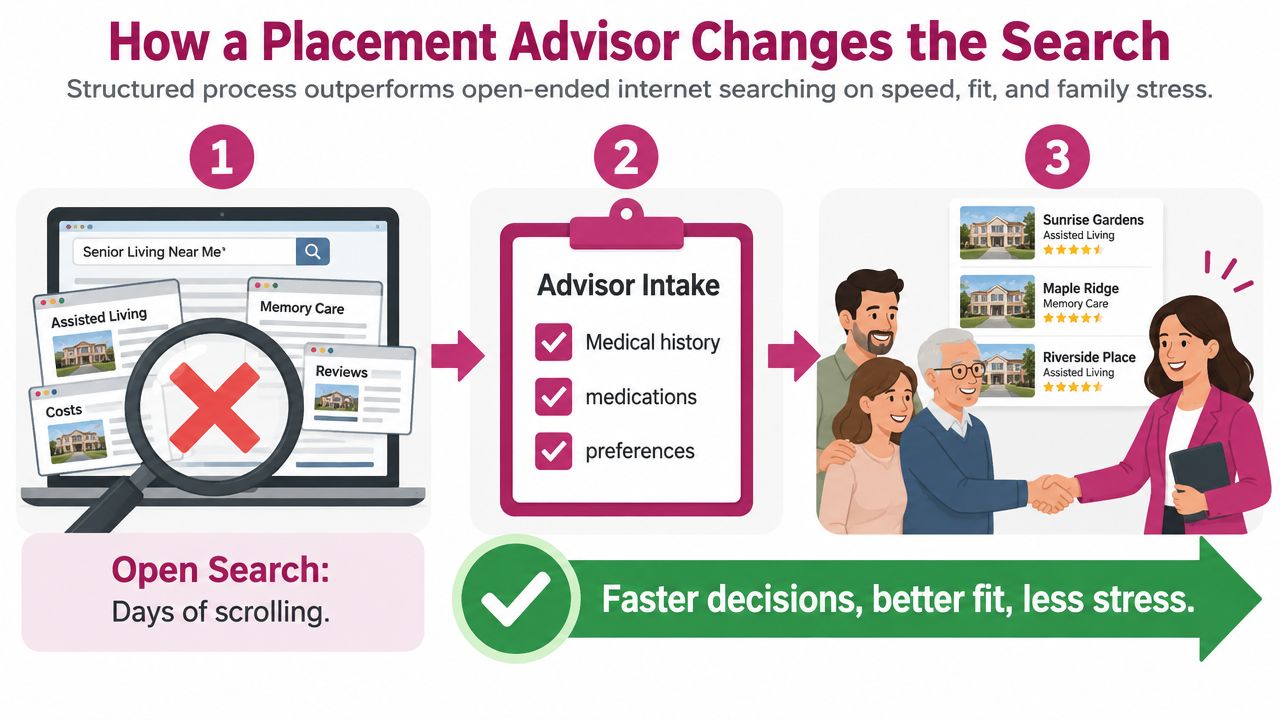
Life Senior Placement is one New Jersey option in this space. It matches families with licensed communities across assisted living, memory care, nursing homes, independent living, and home care, and it offers no-cost guidance through the search and move-in process. When discharge timing is short, that kind of support keeps families from making a rushed choice that fails three months later.
The advisor's job is speed, fit, and fewer bad tours. That makes the contract review cleaner and the decision sharper. In New Jersey, where care needs can shift quickly, that matters more than polished sales talk.
A Practical Step-by-Step Plan for Choosing
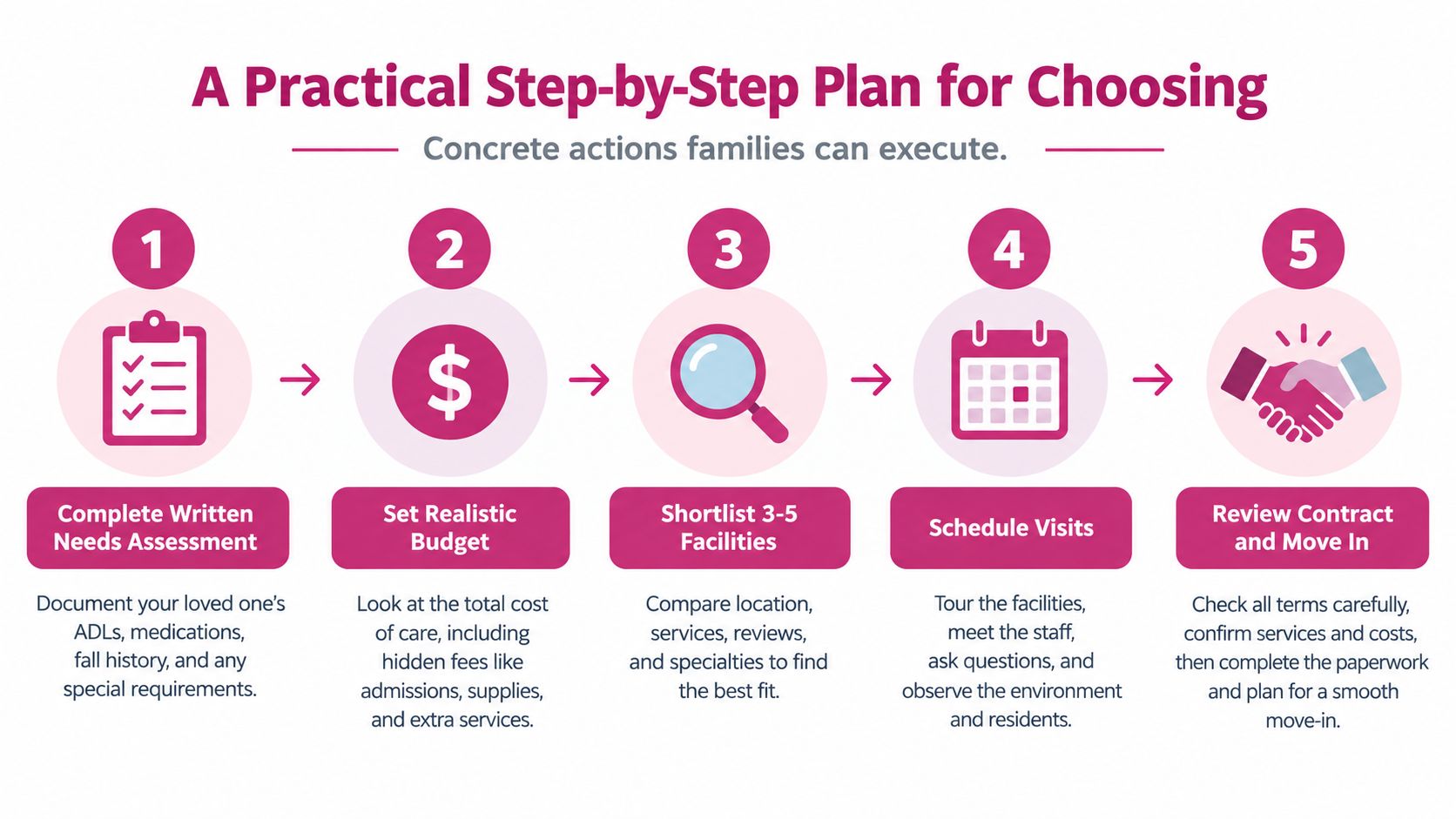
Start six weeks before the target move-in date. Families that wait until a discharge call or a bad weekend fall into panic mode and make sloppy choices.
Write a needs assessment first. List ADLs, medications, falls, cognition, and any nighttime confusion. Build the budget with room, care fees, medication costs, and likely extras, because hidden charges are where families get surprised. Then narrow the field to three to five communities within a realistic driving radius and visit more than once.
Use unannounced drop-ins. That is when you see the actual staffing pattern, meal quality, and tone of the building. Pay close attention to how staff speak to residents when nobody is performing for visitors.
Before signing anything, ask direct questions about turnover, contract exit clauses, care-plan escalation, and what happens if needs change. If the finances are significant or the terms feel unclear, have an elder-law attorney review the residency agreement. That is basic protection.
In New Jersey, verify the facility's most recent state inspection results through the NJ Department of Health portal and confirm that the community holds an active assisted living license, not a different designation. A polished tour does not tell you whether the license matches the care the family is buying.
When a family is torn between assisted living, memory care, and a nursing home level need, the mistake is trying to force one setting to do every job. Use the tour to test the boundary. Ask who handles wandering, medication refusal, nighttime exits, wound care, and rapid decline. If the answers sound vague, the fit is wrong.
Reassessing Over Time and Planning Ahead
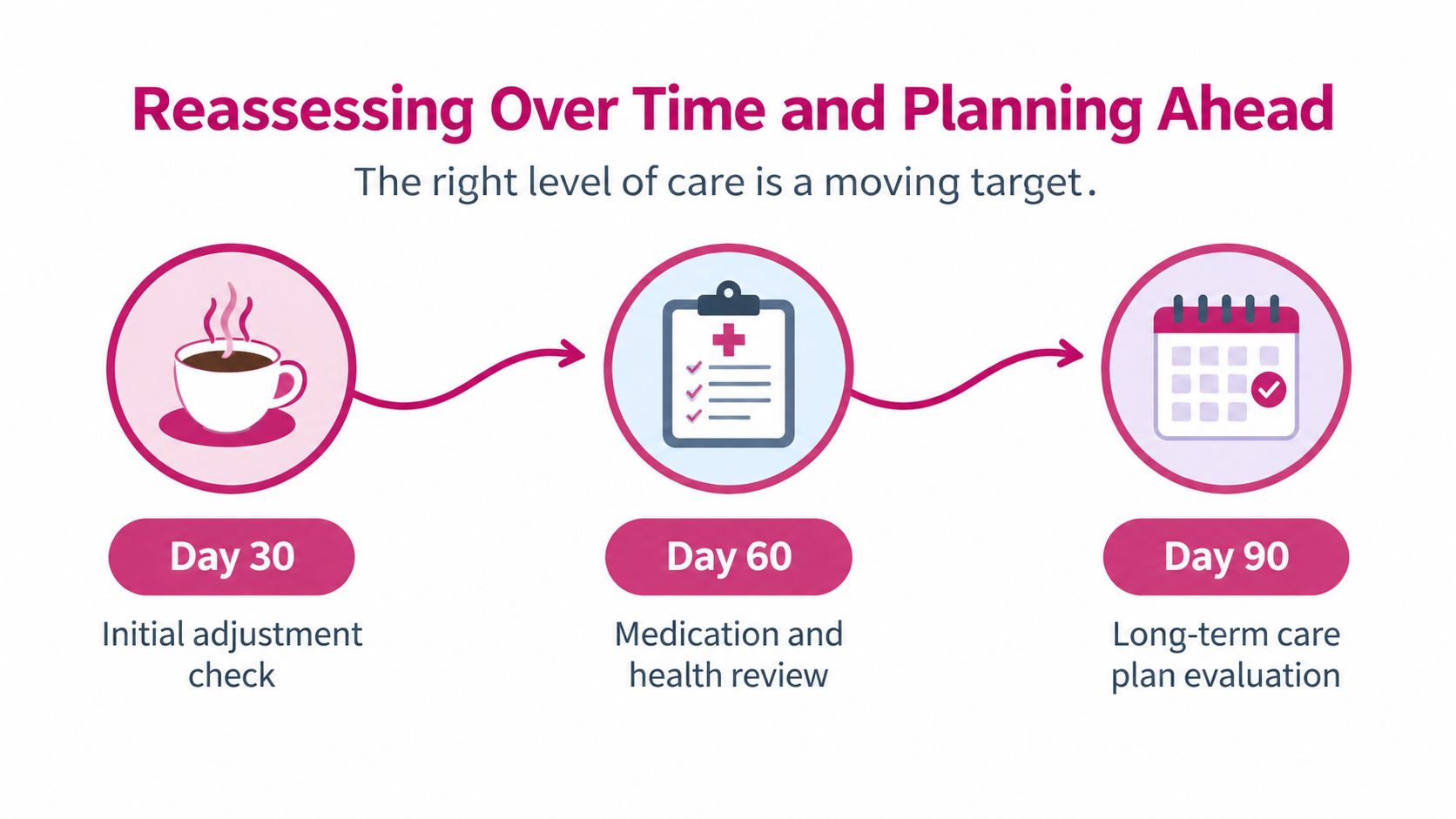
The right setting today may not be the right setting six months from now. Good families don't treat placement as a one-time decision. They build in checkpoints and watch for change.
Watch the early adjustment window
The first 30, 60, and 90 days after move-in matter. That's when the care plan should be compared against actual behavior, appetite, sleep, falls, and medication needs. If the person is struggling, the plan needs to be adjusted fast instead of being defended on paper.
Certain changes should trigger an immediate review. A second fall within six months, a new dementia diagnosis, a hospital stay longer than five days, or sudden weight loss all deserve attention. Those are signs that the current setting may already be too light.
A smart family also plans the next step before a crisis forces it. If memory care might become necessary, ask about internal transfer options inside the same campus so you're not starting over from zero. That reduces chaos and keeps the transition within a familiar system.
The bigger lesson is simple. The right level of care is a moving target, and the best protection is ongoing reassessment plus a trusted advisor who knows when the fit has changed. If you're facing that decision now, use Life Senior Placement to narrow the options, compare licensed communities, and get a New Jersey placement plan that matches your parent's actual needs.